10 Different Methods to Get Testimonials
Here is the uncomfortable truth about testimonials: the happiest customers almost never write one unless you ask. They are busy, they assume you already know they are happy, and a blank page feels like homework. So the testimonials you end up with are not a measure of how good you are. They are a measure of how well you ask.
The good news is that asking does not have to feel awkward or salesy. There are plenty of natural ways to invite feedback, and the best approach is usually to use a few of them together. Below are 10 different methods to get testimonials, with notes on when each one works best and how to keep it human.
Why Testimonials Are Worth the Effort
Before the how, a quick reminder of the why. People trust other people far more than they trust brands. A line from a real customer does something your own marketing never can: it removes doubt. It is social proof that says this worked for someone like me, so it will probably work for me too.
That trust translates directly into decisions. A prospect comparing two similar options will lean toward the one with believable, specific testimonials. In a crowded market, the proof you collect is often the thing that tips the scale.
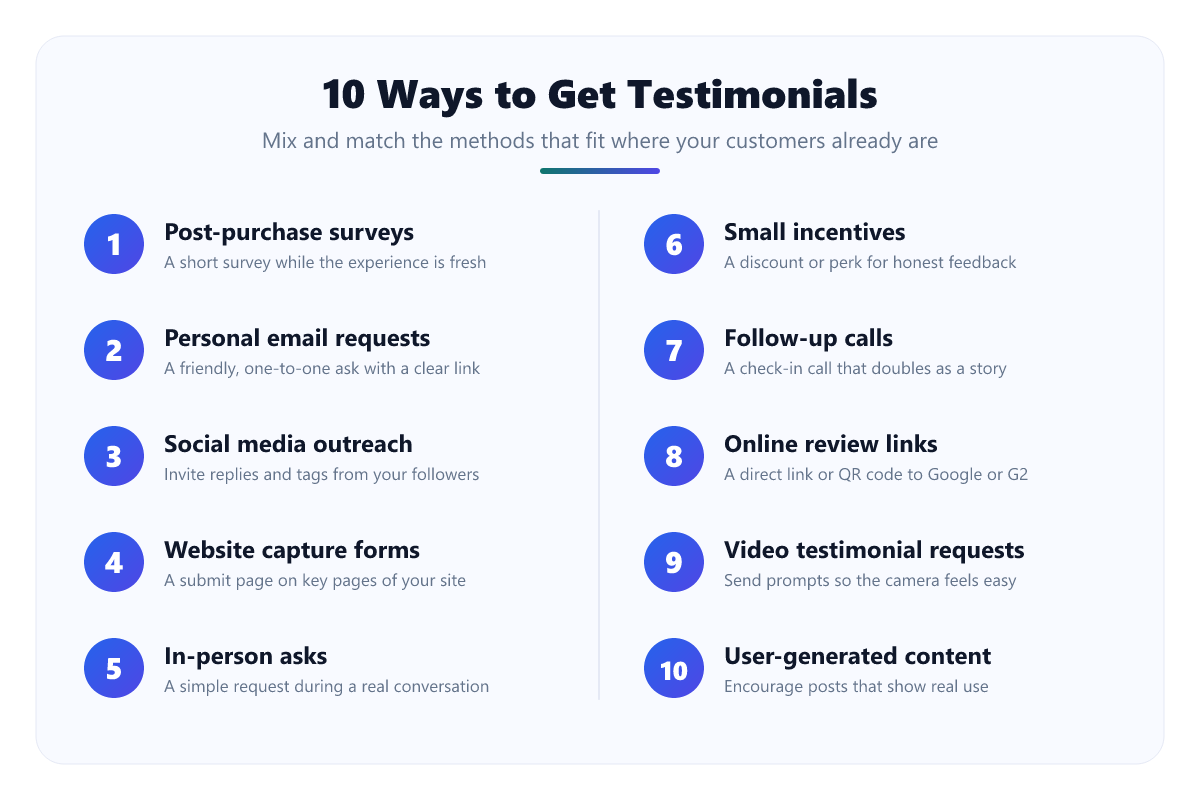
10 Methods to Get Customer Testimonials
1. Post-Purchase Surveys
Send a short survey soon after someone buys or finishes onboarding, while the experience is still fresh. Keep it to one or two focused questions, such as what problem they were solving and what changed for them. A great answer to an open question often reads like a ready-made testimonial, and short surveys get far higher response rates than long ones.
2. Personal Email Requests
A direct, friendly email is still the workhorse of testimonial collection. The key is to make it feel one-to-one rather than like a mass blast. Use their name, mention something specific about their experience, set a low bar (a sentence or two is plenty), and include a single link so they do not have to figure out where to reply.
3. Social Media Outreach
Your followers are already talking. Make it easy for them to say something nice by asking directly in a post or story, replying to positive comments with a gentle prompt, or running a simple question like what is the one thing you would tell a friend about us. Public replies and tags double as testimonials you can screenshot and reuse.
4. Website Capture Forms
Put a submission form where happy customers already are: your homepage, a pricing page, or a dedicated testimonials page. Ask for a name, role, and a short story, and let people choose between writing a few lines or recording a quick video. A good collection page removes friction by not forcing anyone to create an account.
5. In-Person Requests
If you meet customers face to face, at events, in store, or on a call, there is no more natural moment to ask. A simple line like would you mind sharing a few words about how it has gone works because it is genuine and low pressure. Follow up with a link afterward so they can submit when they have a minute.
6. Small Incentives
A little thank-you can nudge people who are willing but never get around to it. Think a discount on their next order, entry into a monthly giveaway, a useful free resource, or early access to a new feature. One important caveat: always ask for honest feedback rather than a positive review, and disclose the incentive when you publish, so you stay on the right side of advertising guidelines.
7. Follow-Up Calls
A check-in call to see how things are going is good for the relationship and a great source of stories. When a customer says something glowing on the phone, that is your cue. Ask if you can quote them, or offer to write up what they said and send it over for approval. Spoken feedback is often more specific and emotional than what people type.
8. Online Review Links
After a clearly positive interaction, point customers to where a public review helps most, like Google or an industry platform such as G2 or Capterra. Make it effortless with a direct link or a QR code. Public reviews build trust with people who have never heard of you and can be repurposed as testimonials on your own site.
9. Ask for Video Testimonials
Video is the most persuasive format because it carries a face, a voice, and real emotion. It is also the one people are most nervous about, so set them up to succeed. Send the questions in advance, keep it short (60 to 90 seconds), and reassure them that phone footage is perfectly fine. Never spring a recording request on someone with no warning.
10. User-Generated Content Campaigns
Invite customers to share photos or posts of themselves actually using your product, often around a branded hashtag or a small contest. This content feels like a recommendation from a friend rather than an ad, which is exactly why it works. Reposting it (with permission) gives you a steady stream of authentic proof and rewards the customers who took part.
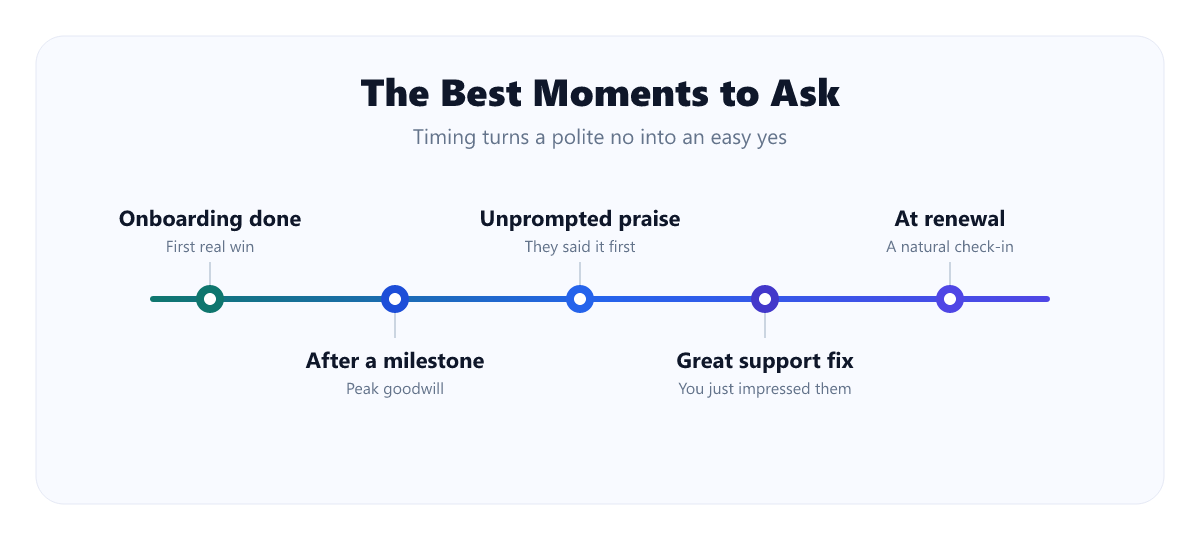
Time Your Ask for an Easy Yes
The method matters, but timing decides whether you get a response at all. The best moment to ask is right after a customer feels the value: when onboarding wraps up and they hit their first win, just after a milestone or great result, when they pay you an unprompted compliment, right after your support team saves the day, or at renewal when satisfaction is already on the table. Avoid asking during an active problem or a tense negotiation, no method survives bad timing.
Make Collection a System, Not a Scramble
Most businesses ask for testimonials in bursts, then forget for months and end up with a few stale quotes. The teams with great testimonial libraries treat it like a habit: they pick a trigger, send the request automatically, collect submissions on a single branded page, and follow up once if there is no reply.
Prooflet is built for exactly this loop. You can send branded requests by email, let customers submit a written or video testimonial without friction, and then organize and display the best ones in a Wall of Love or an embeddable widget. If you are collecting testimonials by hand today, automating the routine parts is the fastest way to get more of them.
Frequently Asked Questions
1. What is the best method for collecting testimonials?
There is no single best method. The strongest results come from combining a few, for example a personal email after onboarding, a website form for ongoing submissions, and a video request for your happiest customers. Match the method to where your customers already spend their time.
2. How do I ask for a testimonial without sounding pushy?
Keep it personal, set a low bar, and remove pressure. Mention something specific about their experience, ask for just a sentence or two, include a direct link, and add a genuine no worries if now is not a good time. A request that respects their time rarely feels pushy.
3. When is the best time to request a testimonial?
Right after a customer feels real value: at the end of onboarding, after a milestone or strong result, following an unprompted compliment, or after your support team resolves an issue well. Renewal is another natural checkpoint. Avoid asking during an active problem.
4. Are video testimonials more effective than written ones?
Video tends to feel more credible and holds attention longer, which is why it often converts better. Written testimonials are faster to collect and easier to scan. Most high-performing pages use a mix of both rather than relying on one format.
5. Can I automate testimonial collection?
Yes. You can automate the trigger and timing, sending a request when a customer hits a milestone, and collect responses on a dedicated page. A tool like Prooflet handles the requests, follow-ups, and display so the only manual step left is choosing which testimonials to feature.