
Testimonial: Definition, Meaning and 8 Types
Updated

On this page
- What Does Testimonial Mean?
- The 8 Types of Testimonial
- Testimonial vs Testimony vs Review vs Endorsement
- Testimonial in a Sentence
- How to Pronounce Testimonial
- How to Spell Testimonial
- Testimonial Meaning in Business vs Legal Contexts
- Why Testimonials Build Trust
- 10 Testimonial Examples by Industry
- 1. Education
- 2. E-commerce
- 3. Healthcare
- 4. Real Estate
- 5. HR and Recruiting
- 6. Professional and Service Providers
- 7. Travel and Hospitality
- 8. Software and Technology
- 9. Automotive
- 10. Legal Services
- What Makes a Testimonial Actually Convincing
- How to Write or Collect a Testimonial That Works
- Questions for written testimonials
- Questions for video testimonials
- Collecting Testimonials Without Chasing Them
- Frequently Asked Questions
A testimonial is a written, recorded, or spoken statement in which a customer, client, or colleague describes their experience with a product, service, or person. There are 8 types. Testimonials differ from reviews in origin: a review is left publicly on a third-party platform, while a testimonial is given directly to the business and published with permission.
In short: a testimonial is a statement from a customer describing their experience with a product or service, given directly to the business and published with permission. A review, by contrast, is posted independently on a third-party platform. There are eight common types: quote, video, social post, case study, peer, audio, interview, and success story.
For a larger set of examples with notes on why each one works, see 20 testimonial examples that convert.
What Does Testimonial Mean?
The word comes from the Latin testimonium, meaning evidence or witness. A testimonial is a person bearing witness to their own experience: what things were like before, what they used, and what changed. It is feedback in their own words, not marketing copy.
That is the whole reason testimonials work. When a company says its software is easy to use, it reads as a sales claim. When a customer says they had it set up in ten minutes without opening a help doc, it reads as fact, because it came from someone with nothing to sell.
The word has three uses:
- Noun, marketing: a customer statement published by a business. This is the common meaning, and the one this guide covers.
- Noun, general: a statement vouching for someone's character or ability, such as a reference letter. See our guide to asking for testimonials.
- Adjective: something given in tribute, such as a testimonial dinner or, in UK football, a testimonial match played in honor of a long-serving player.
“I was skeptical that a team as small as ours could pull this off, but we were live over a weekend. Three months later it is the first tool everyone opens in the morning.”
Example: operations manager, software customer
The 8 Types of Testimonial
Each type suits a different page and a different buyer. Here is each one in a line, with an example.
- Quote: one to three written sentences with a name and photo. Example: “Cut our support tickets by 40% in the first month.”
- Video: a customer on camera for 30 to 90 seconds. Example: a founder explaining on screen how they replaced three tools with one.
- Social post: an unprompted post on X, LinkedIn, or Instagram, embedded or screenshotted with permission. Example: a customer tagging you in a post about their launch.
- Case study: a structured story of problem, solution, and measured result, 500 to 1,500 words. Example: “How a 12-person agency saved 20 hours a week.”
- Peer or influencer: an endorsement from someone the buyer already trusts, either a person in their own role or a creator with an audience. Example: a head of marketing recommending you to other heads of marketing.
- Audio: a 20 to 60 second voice clip, embedded on a page or used in a podcast. Example: a coaching client describing their first win in their own voice.
- Interview: a question-and-answer format, written or recorded, that goes deeper than a quote. Example: five questions and answers with a long-term client.
- Success story: a narrative of one customer's transformation, less formal and less data-heavy than a case study. Example: a student describing how a course got them their first job.
Testimonial vs Testimony vs Review vs Endorsement
These four words overlap, and they are often confused. The differences come down to who gives the statement, where it lives, and whether it is formal.
| Term | What it is | Where it appears | Example |
|---|---|---|---|
| Testimonial | A statement of experience given directly to a business and published with permission | The business's website, ads, and sales material | A client quote with name and photo on a homepage |
| Testimony | A formal statement given under oath | Courts, hearings, and official inquiries | A witness describing events in court |
| Review | An independent opinion, positive or negative, posted by the customer | Third-party platforms such as Google, G2, and Trustpilot | A 3-star Google review of a restaurant |
| Endorsement | Public support from a known person, often paid | Ads, packaging, and social media | An athlete promoting a sports drink |
A testimonial and a review can contain identical words. What separates them is origin: the business asks for and publishes a testimonial, and the customer publishes a review independently. For review-specific advice, see good review examples and templates.
Testimonial in a Sentence
Testimonial works as a noun and, less often, as an adjective. Five example sentences:
- We added a customer testimonial directly below the pricing table.
- Her testimonial described how the course helped her land a job within three months.
- The agency asked each client for a short video testimonial after the project closed.
- The club held a testimonial match to honor the captain's 15 years of service.
- Every testimonial on the page carries a real name, a photo, and one specific result.
How to Pronounce Testimonial
Testimonial has five syllables, with the stress on the third: tes-tuh-MOH-nee-ul.
- American English: /ˌtes.təˈmoʊ.ni.əl/
- British English: /ˌtes.tɪˈməʊ.ni.əl/
The only difference is the vowel in the second and third syllables. The stress falls on “MOH” in both.
How to Spell Testimonial
The correct spelling is testimonial, plural testimonials. Two misspellings are common: “testimonal” (missing the second i) and “testamonial” (an a instead of the first i, from confusion with “testament”). To remember it, spell out the root word first: testimony, then add “-al” in place of the final y.
Testimonial Meaning in Business vs Legal Contexts
In business, a testimonial is a customer statement used as social proof, and it is the meaning everywhere else on this page. In law, testimonial evidence is a statement made by a witness under oath, and in US criminal law, a “testimonial statement” is one made for use in prosecution, which the defendant has a right to confront under the Sixth Amendment (Crawford v. Washington, 2004). The two meanings share a root, but they have nothing else in common.
Why Testimonials Build Trust
A testimonial answers the question every buyer is asking: can I believe this? Four reasons a few sentences from a customer carry so much weight:
- They are social proof. If people like me chose this and stayed, it is a safer bet.
- They lower perceived risk. Hearing how someone else avoided the worst case takes the fear out of the decision.
- They are specific. Real customers mention details a brand would never invent, and those details make a claim believable.
- They are relatable. A reader sees their own problem in someone else's story.
10 Testimonial Examples by Industry
The fastest way to understand the definition is to read a few. Here are 10 short examples across different industries, each written the way a real customer talks. For 15 longer examples with a breakdown of why each one converts, see our testimonial examples guide.
1. Education
Parents and students lean on testimonials to decide whether a course, tutor, or school is worth their time and money.
“My daughter went from dreading math to asking for extra practice. The tutors actually explained the why behind every step instead of just handing her the answer.”
Maria T., parent of a Grade 8 student
2. E-commerce
Online shoppers cannot touch the product, so a buyer's words do the reassuring that photos cannot.
“I ordered a size up like the reviews suggested and the fit was perfect. It arrived two days early, and the fabric feels far more premium than the price would suggest.”
Verified buyer
3. Healthcare
Choosing a clinic or provider is stressful. Patient stories calm nerves better than any brochure.
“I put the procedure off for a year because I was scared. The team walked me through every step and even called to check on me afterward. My only regret is not doing it sooner.”
Recovered patient
4. Real Estate
Agent testimonials prove local knowledge and the ability to manage a high-stakes, high-stress transaction.
“We were relocating across the country with two kids and a hard deadline. Our agent found us a home in nine days and quietly handled the parts that usually keep buyers up at night.”
First-time homebuyer
5. HR and Recruiting
Job seekers read employee testimonials to understand the culture before they ever apply.
“Five years in and I am still learning. Leadership actually means it when they talk about growth. I have changed roles twice, and they paid for the training both times.”
Senior analyst
6. Professional and Service Providers
For consultants, agencies, and trades, a client testimonial signals reliability and clear communication.
“We hired them to untangle our messy bookkeeping and ended up with a system the whole team understands. They showed up on time, explained everything in plain English, and left the place tidier than they found it.”
Small business owner
7. Travel and Hospitality
Travelers want to know what a place is really like before they commit a vacation to it.
“The room photos did not do it justice. Spotless, quiet, and a five-minute walk from everything. The front desk remembered our names by day two.”
Hotel guest
8. Software and Technology
Buyers of software care about setup time, day-to-day usability, and whether support has their back.
“Onboarding three new hires used to eat a full week. Now we do it in an afternoon, and the dashboard actually tells us what is happening instead of making us guess.”
Operations lead
9. Automotive
Car buyers and service customers are wary of pressure and surprise fees, so honesty stands out.
“No pressure and no surprise charges. The salesperson laid out every number up front, and the car has been flawless for 20,000 miles.”
New car owner
10. Legal Services
Legal clients are often anxious, so testimonials that highlight communication and responsiveness carry real weight.
“I was nervous about the whole case, but my attorney replied to every email within hours and never made a single question feel silly. The outcome was better than I hoped for.”
Former client
What Makes a Testimonial Actually Convincing
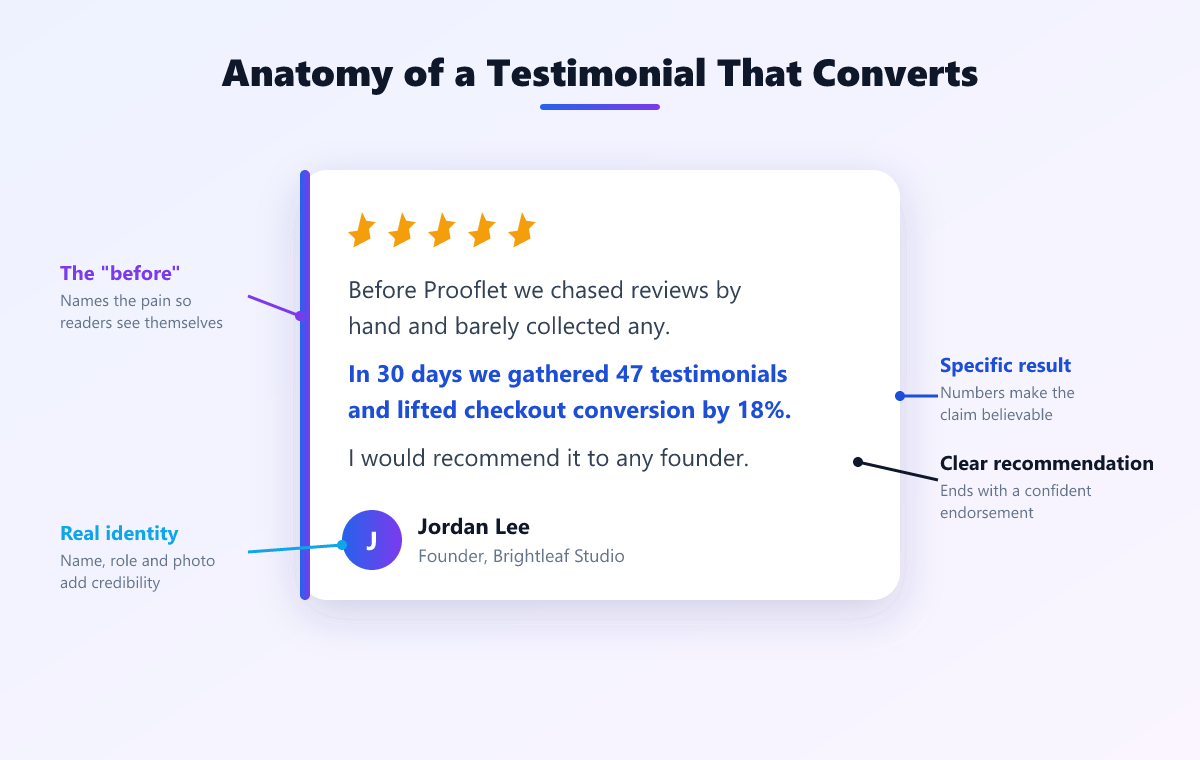
Look closely at the examples above and you will notice they share a structure. The most persuasive testimonials almost always include these ingredients:
- A clear before. They name the problem the customer had, so readers recognize their own situation.
- A specific result, ideally with a number. “Saved us a full day a week” beats “really helped us” every time.
- Plain, human language. Real people do not talk in marketing slogans, and the lack of polish is what makes it believable.
- A genuine recommendation. A confident line at the end (“I would recommend it to any founder”) gives the reader permission to say yes.
- A real identity. A full name, role, company, and photo turn an anonymous quote into a person you can trust.
How to Write or Collect a Testimonial That Works
You rarely get a great testimonial by asking a customer to “say something nice.” A blank page is intimidating. The trick is to make it easy and to ask at the right time. If you are the one writing it, our guide on how to write a testimonial has a template and 10 examples.
- Ask right after a win. A milestone, a great result, or an unprompted compliment is the perfect cue.
- Ask specific questions instead of leaving them to figure out what to write.
- Make it effortless with a single link or a short form. Every extra step costs you responses.
- Get permission to use their name, role, company, and photo before you publish.
- Edit only lightly, fixing typos without changing the meaning, then confirm the final version with them.
Questions for written testimonials
- What was going on before you found us?
- What made you decide to give us a try?
- What is the biggest difference now?
- What would you say to someone who is on the fence?
Questions for video testimonials
- Introduce yourself and tell us what you do.
- What problem were you trying to solve?
- What surprised you most after getting started?
- Who would you recommend this to, and why?
Collecting Testimonials Without Chasing Them
Knowing what a great testimonial looks like is one thing. Collecting them consistently is another. Most teams ask once in a while, lose track of who said yes, and end up with three quotes from two years ago.
Prooflet is built for the entire loop: send a branded request, let customers record a video or type a quote on a simple page, then organize and display the best ones in a Wall of Love or an embeddable widget. If you are still gathering testimonials by copy and paste, it is worth a look, and if you are weighing up tools, our Senja vs Testimonial.to vs Famewall comparison covers the pricing and trade-offs of the most common options.
Frequently Asked Questions
1. What is a testimonial?
A testimonial is a written, recorded, or spoken statement in which a customer, client, or colleague describes their experience with a product, service, or person. It is given directly to the business and published with permission, and it works as social proof.
2. What's the difference between a testimonial and a review?
The difference is origin. A testimonial is given directly to the business and published with permission, usually with the person's name, role, and photo. A review is posted independently on a third-party platform such as Google or G2, can be positive or negative, and the business does not control it.
3. What are the types of testimonials?
There are eight common types: quote, video, social post, case study, peer or influencer, audio, interview, and success story. Quotes are the fastest to collect, and video is the most persuasive because the viewer sees a real face and hears a real voice.
4. How do you use testimonial in a sentence?
Use it as a noun for a statement of support or experience. For example: “We added a customer testimonial next to the pricing table.” It also works as an adjective, as in “a testimonial dinner” held to honor someone.
5. Is a testimonial the same as testimony?
No. Testimony is a formal statement given under oath, in court or before an official body. A testimonial is an informal statement of experience or support, most often a customer describing a product or service. They share a Latin root, testis, meaning witness.