How Google Reviews Impact Your Local SEO (and How to Use Them)
Updated

On this page
- Do Google reviews actually affect SEO?
- The three pillars of local ranking
- How Google reviews influence rankings, signal by signal
- Review quantity
- Average rating
- Review recency and velocity
- Keywords inside reviews
- Owner responses
- The local map pack, and why it is the whole game
- How reviews stack up against other local ranking factors
- How to get more Google reviews
- Why responding to every review matters for SEO
- Go beyond Google: reviews across platforms
- Turn reviews into on-site SEO wins
- A 90-day plan to grow your Google reviews and local visibility
- Days 1 to 30: fix the foundation and start asking
- Days 31 to 60: build the habit and respond
- Days 61 to 90: amplify and display
- Mistakes that quietly cap your review SEO
- Frequently asked questions
- Do Google reviews help SEO?
- How many Google reviews do I need to rank?
- Does responding to Google reviews help SEO?
- Do negative reviews hurt my ranking?
- Can I show my Google reviews on my website?
Ask a local business owner what drives new customers and most will say word of mouth. What they often miss is that Google reviews are word of mouth, scaled and indexed, and they quietly shape who shows up first when someone nearby searches for what you sell. Reviews are one of the few things that make you more persuasive and more findable at the same time.
Quick answer: Yes, Google reviews directly affect local SEO. Google factors the number of reviews, your average rating, how recent they are, the language inside them, and whether you respond into how it ranks businesses in local search and the map pack. More high-quality, recent reviews with owner responses generally mean better local visibility.
This guide explains exactly how reviews feed local rankings, then gives you a practical plan to earn more and convert the visibility into customers. If you want the step-by-step request playbook first, see how to ask for a review.
Do Google reviews actually affect SEO?
They do, but it helps to be precise about which kind of SEO. Reviews have a strong, well-documented influence on local search: the results that appear with a map, addresses, and star ratings when someone searches for a business or a “near me” query. Their effect on traditional, non-local organic rankings is far more indirect.
Google itself names reviews as part of how it ranks local results, alongside relevance and distance. So for any business that serves a geographic area, a clinic, a law firm, a restaurant, a contractor, reviews are not a nice-to-have. They are a ranking input you can actively improve.
The three pillars of local ranking
Google ranks local results on three broad factors. Reviews touch all three, but they dominate the third.
- Relevance. How well your business matches the search. This comes mostly from your Google Business Profile categories, services, and description, but the words customers use in reviews add relevant context too.
- Distance. How close you are to the searcher. You cannot change your location, but a strong reputation can help you rank for searchers a little farther out.
- Prominence. How well known and well regarded your business is. This is where reviews carry the most weight. Quantity, rating, and recency of reviews are core prominence signals.
How Google reviews influence rankings, signal by signal
“Reviews help SEO” is true but vague. Here is what Google actually appears to weigh, and what to do about each.
Review quantity
More reviews generally signal a more established, trusted business. A profile with 150 reviews reads as more prominent than one with 12, all else equal. You do not need thousands, but you want clearly more than the competitors showing up next to you in the map pack.
Average rating
Rating influences both ranking and the click that follows it. A higher star average tends to support better placement and, just as importantly, earns more clicks once you appear. Counterintuitively, a near-perfect 5.0 with very few reviews can look less trustworthy than a 4.6 backed by hundreds.
Review recency and velocity
A steady flow of recent reviews signals an active, healthy business. A burst of reviews two years ago followed by silence suggests the opposite. This is why a consistent collection habit beats a one-time push: freshness is itself a signal.
Keywords inside reviews
When customers naturally mention the service and location, “great emergency plumber in Austin,” those words add relevant language to your profile that you could never credibly write yourself. You should never script reviews, but prompting customers to describe what you did and where helps these phrases appear organically.
Owner responses
Replying to reviews signals an engaged business and gives Google more fresh, relevant text on your profile. Google has publicly encouraged owners to respond, and a consistent reply habit correlates with stronger profiles. It also influences customers reading along, which we cover in how to respond to negative reviews.
The local map pack, and why it is the whole game
For local searches, the prize is the map pack: the boxed set of three businesses shown with a map above the standard results. Studies consistently show the map pack captures a large share of clicks for local queries, often more than the organic links beneath it. Reviews are one of the strongest levers for getting into it, because review count, rating, recency, and responses all feed the prominence that decides those three slots. In practice, climbing into the map pack is one of the highest-return things a local business can do, and reviews are central to it.
How reviews stack up against other local ranking factors
Reviews are powerful, but they work alongside other signals. This rough breakdown shows where review-related factors fit so you can balance your effort.
| Factor | What it covers | Where reviews fit |
|---|---|---|
| Google Business Profile signals | Categories, completeness, accuracy, photos | Foundational; reviews amplify a complete profile but cannot replace one |
| Review signals | Quantity, rating, recency, keywords, responses | A leading driver of prominence and one of the most actionable |
| On-page and website signals | Relevant content, location pages, mobile experience | Displaying reviews on-site adds fresh, relevant content |
| Links and citations | Consistent name, address, phone across the web; backlinks | Reputable review profiles double as citations |
| Behavioral signals | Clicks, calls, direction requests from your listing | A high rating lifts click-through, which reinforces prominence |
The practical reading: nail your profile basics first, then treat reviews as the highest-leverage ongoing investment. They feed prominence directly and quietly strengthen several of the other factors at the same time.
How to get more Google reviews
The ranking benefit only materializes if you actually collect reviews consistently. The fundamentals are simple:
- Make it effortless. Use the short review link or QR code from your Google Business Profile and put it everywhere: email signatures, receipts, texts, and a card at your counter.
- Ask at the peak moment. Request right after a clear win, when the customer is happiest and the details are fresh.
- Ask everyone, gate no one. Do not filter so only happy customers are invited; that violates Google's policy. Ask all customers and let your work determine the ratings.
- Follow up once. Most reviews come on the second touch. A single gentle reminder recovers many.
- Never pay for reviews. Incentivized or fake reviews break Google's rules and risk your profile.
For timing tables, channel comparisons, and copy-paste templates, see our complete guide on how to ask for a review. If you want the requests to send themselves at the right moment, that is exactly what Prooflet automates.
Why responding to every review matters for SEO
Responses do triple duty. They add fresh, keyword-relevant text to your profile, they show Google an active business, and they show prospective customers that you listen. Reply to positive reviews with a brief, specific thank-you. Reply to negative ones calmly, acknowledge the issue, and offer to make it right. A thoughtful response to criticism often impresses readers more than a wall of flawless five-star ratings. The full playbook, including templates and phrases to avoid, is in our guide to handling negative reviews.
Go beyond Google: reviews across platforms
Google is the anchor, but it is not an island. Reviews on other reputable platforms, your industry's main directory, Trustpilot, Facebook, contribute to your overall prominence and reach buyers who research elsewhere. Diversifying also protects you if a single platform filters or hides reviews. To decide which additional sites are worth your effort, see our roundup of the best customer review sites by industry.
Turn reviews into on-site SEO wins
Here is the move most local businesses miss: reviews sitting on Google only help the people who find your Google profile. Bringing them onto your own website multiplies their value. Displayed reviews add fresh, relevant content to your pages, can earn star rating snippets in search results when marked up correctly, and reassure the visitors who land on your site directly.
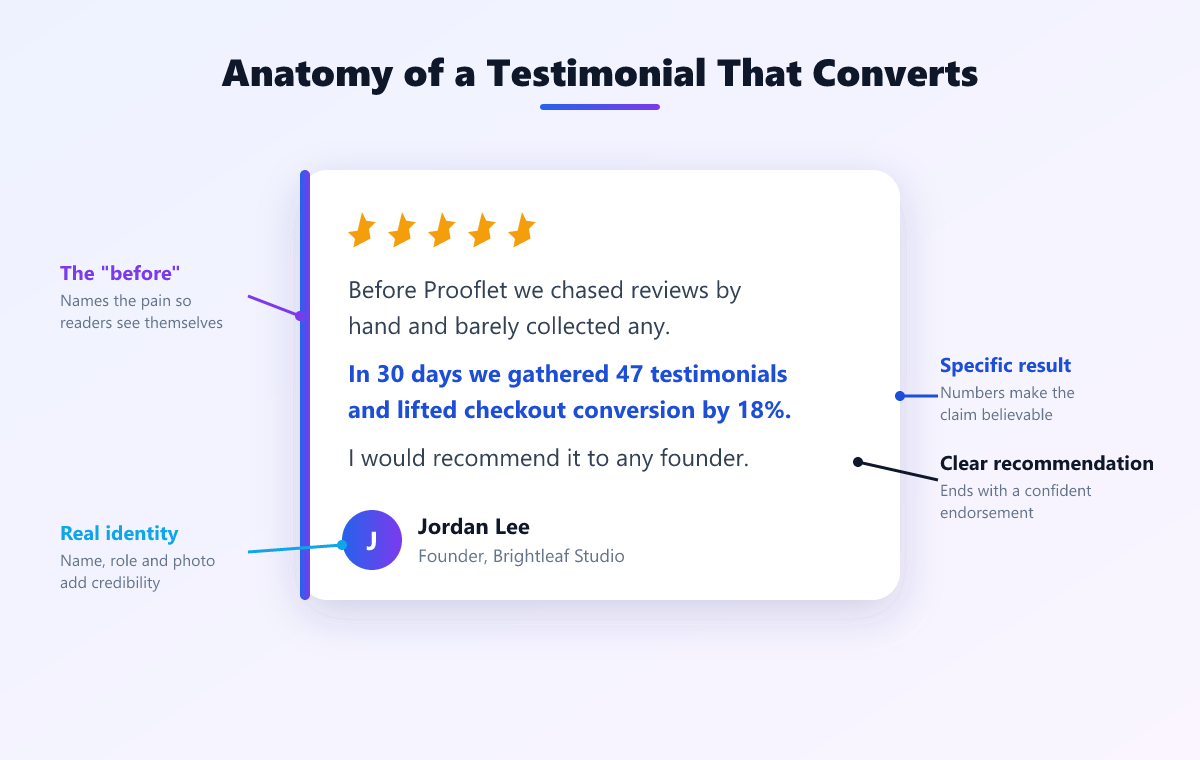
With Prooflet you can collect written and video testimonials, import the reviews you have already earned, and publish the strongest ones as a Wall of Love or embeddable widget on your homepage and service pages. The same reputation that lifts your map pack ranking then works a second time on the visitors who arrive at your site. For more on the format, our explainer on what a testimonial is, with examples shows what convincing on-site proof looks like.
A 90-day plan to grow your Google reviews and local visibility
Visibility from reviews is a compounding result, not an overnight one. Here is a realistic quarter-long plan that builds it.
Days 1 to 30: fix the foundation and start asking
Complete every field of your Google Business Profile: categories, services, hours, description, and fresh photos. Generate your short review link and QR code, and add them to your email signature, receipts, and a counter card. Then work through your recent happy customers and send each a personalized request on the channel they already use with you.
Days 31 to 60: build the habit and respond
Turn the ask into a routine that triggers right after every job or purchase, with one automatic follow-up for non-responders. Start replying to every review within a day or two, briefly and specifically. By now a steady trickle of fresh reviews should be appearing, which is exactly the recency signal Google rewards.
Days 61 to 90: amplify and display
Add a second reputable platform if it fits your industry, so your prominence is not tied to one profile. Pull your strongest reviews onto your website as a widget, and make sure they are marked up so they can earn star snippets. Watch your map pack position and call volume; both should be trending up as the review base grows and stays fresh.
Mistakes that quietly cap your review SEO
- An incomplete Google Business Profile. Missing categories, hours, photos, and descriptions weaken relevance no matter how many reviews you have.
- Letting reviews go stale. A great rating from two years ago does little for current prominence.
- Ignoring negative reviews. Silence reads as indifference to both Google and prospects.
- Gating or buying reviews. Both violate Google's policies and risk removal or suspension.
- Keeping reviews trapped on Google. Failing to display them on your site leaves conversion and on-page SEO value on the table.
Reviews are one of the rare marketing investments that compound. Each one makes you a little more findable and a little more convincing, and a steady habit of collecting, responding, and displaying them pays off month after month.
Frequently asked questions
Do Google reviews help SEO?
Yes, especially local SEO. Google uses the number, rating, recency, and content of your reviews, along with your responses, as prominence signals when ranking businesses in local search and the map pack. Their effect on standard, non-local organic rankings is much more indirect.
How many Google reviews do I need to rank?
There is no fixed number; what matters is having clearly more quality, recent reviews than the competitors appearing alongside you in local results. For many local businesses, getting past the first 20 to 50 reviews and then maintaining a steady flow produces the biggest visibility gains.
Does responding to Google reviews help SEO?
Yes. Responses add fresh, relevant text to your profile, signal an active business to Google, and reassure prospective customers reading along. Google explicitly encourages owners to reply to reviews.
Do negative reviews hurt my ranking?
A few negative reviews rarely hurt and can actually build trust by making your profile look authentic, especially when you respond well. What hurts is a low overall average, no recent reviews, or ignoring complaints entirely. Handle criticism professionally and it becomes a net positive.
Can I show my Google reviews on my website?
Yes, and you should. Displaying reviews on your own pages adds fresh content, can earn star snippets in search, and converts visitors who never see your Google profile. A tool like Prooflet lets you collect, import, and publish reviews as a widget or Wall of Love on your site.