How to Ask for a Review: 10 Templates That Work (2026)
Updated
On this page
- Reviews vs testimonials: ask for the right thing
- How many reviews do you actually need?
- When is the best time to ask for a review?
- Right after a clear win
- When a customer says something kind
- After a positive support interaction
- At a natural milestone
- How to ask for a review in 6 steps
- 1. Pick one platform and link straight to it
- 2. Personalize the opening
- 3. Make the ask explicit and small
- 4. Explain why it helps
- 5. Remove friction
- 6. Follow up once
- The best channels for review requests
- Where should you send people to review you?
- Review request templates you can copy
- Email template (after a delivered result)
- SMS template (same-day, local service)
- In-person script
- Post-purchase (e-commerce)
- After a support ticket is resolved
- Social media DM
- QR code (in person)
- Automated post-milestone request
- The single follow-up
- The incentivised ask, done legitimately
- How to ask for Google reviews specifically
- Mistakes that quietly kill your review rate
- A simple 30-day plan to get your first 25 reviews
- How to automate review requests without losing the human touch
- Frequently asked questions
- How do I politely ask for a review?
- When should I ask a customer for a review?
- Can I offer an incentive for a review?
- How many times should I follow up?
- What is the difference between a review and a testimonial?
- How do I ask for a review in person?
- Should I automate review requests?
A review request works when it does four things: it arrives within a day or two of a clear win, uses the channel the customer already uses with you, stays short and specific, and links straight to the review page. Here are 10 templates and a 6-step process.
Personalize each request, explain why a review helps, and follow up once if you hear nothing.
This guide breaks down the timing, channels, wording, and follow-up that turn a quiet customer list into a steady stream of public reviews. If you are focused on curated quotes for your own website rather than public platforms, our companion guide on how to ask for testimonials without being awkward covers that angle in depth.
Reviews vs testimonials: ask for the right thing
Before you send a single request, get clear on what you actually want, because the ask is different.
A review is public feedback left on a third-party platform you do not control, like Google, Trustpilot, G2, or Yelp. Reviews can be positive or negative, they carry independent credibility, and on platforms like Google they directly influence local search rankings.
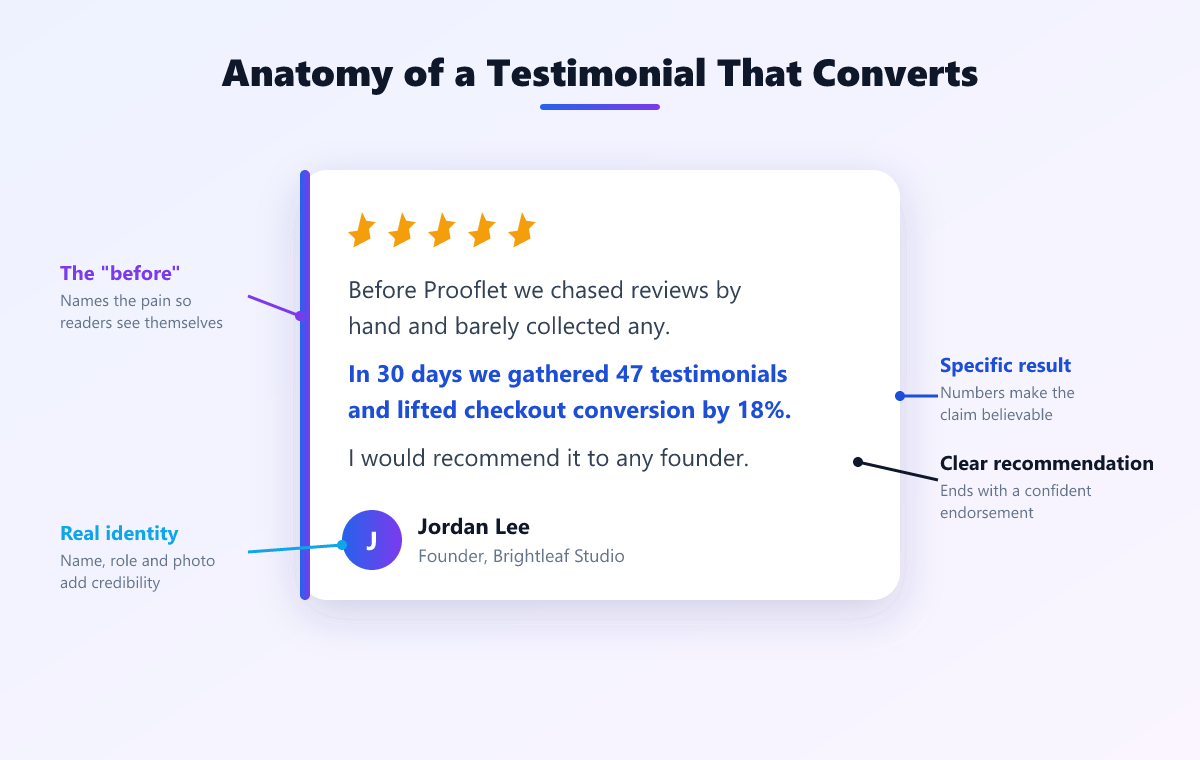
A testimonial is a quote you request, curate, and feature on your own site, usually with the customer's name, role, and photo. You control where it appears and how it looks.
You want both, but they live in different places. This article is about earning public reviews. For a full breakdown of the formats and where each one shines, see our explainer on what a testimonial is, with real examples.
How many reviews do you actually need?
There is no universal number, but the research points in a clear direction: a small base of recent, specific reviews does most of the heavy lifting. Buyers look for three things before they trust a rating, and you can plan your ask around them.
- Enough volume to look established. A handful of reviews reads as new; a few dozen reads as proven. For most local businesses, the first 20 to 50 reviews move the needle the most.
- Recency. Reviews from the last few months carry far more weight than a wall of five-star ratings from two years ago. Shoppers and search engines both favor freshness, which is why a steady trickle beats a one-time push.
- A believable spread. A perfect five-star average with zero critical feedback can read as suspicious. A 4.6 with thoughtful responses to the occasional complaint often converts better than a flawless 5.0.
The practical takeaway: aim for a consistent flow of new reviews rather than a single sprint. Five fresh reviews a month, every month, beats fifty in one week followed by silence.
When is the best time to ask for a review?
The single biggest lever on your review rate is timing. Ask at a peak moment of satisfaction and people say yes. Ask a month later and the emotion has faded.
Right after a clear win
The best moment is immediately after the customer experiences value: a project delivered, a problem solved, a product that arrived and worked, a goal hit. The feeling is fresh and specific, which also produces more detailed reviews.
When a customer says something kind
If a client emails “this is exactly what we needed” or tells you so on a call, that is your cue. A simple “that means a lot, would you be open to sharing that as a quick review?” converts well because you are capturing an opinion they already volunteered.
After a positive support interaction
A support ticket that ends with a relieved, grateful customer is an underrated moment. They just felt taken care of. A short prompt at the close of the conversation rides that goodwill.
At a natural milestone
Renewals, anniversaries, the hundredth order, or the end of an onboarding period are all logical times to ask. The relationship has proven itself, so the request feels earned.
Here is a rough timing guide by business type:
| Business type | Best moment to ask |
|---|---|
| E-commerce | 3 to 7 days after delivery, once the product has been used |
| SaaS | After onboarding, at a usage milestone, or before renewal |
| Local service (trades, salons, clinics) | Same day, right after the service is completed |
| Agencies and consultants | At a project milestone or a measurable result |
| Restaurants and hospitality | End of the visit or within a few hours by SMS |
How to ask for a review in 6 steps
A good request is a small system, not a one-off favor. These six steps work across every channel.
1. Pick one platform and link straight to it
Decide where this review should live before you ask. Sending a customer to “leave us a review somewhere” guarantees inaction. Choose the platform that matters most for your goals (Google for local visibility, G2 or Capterra for software, your industry's main site otherwise) and include a direct link to the review form. Every extra click costs you responses.
2. Personalize the opening
Use their name, reference the specific thing you did together, and write like a human. A line such as “so glad the kitchen remodel came together the way you pictured” signals that this is a real message, not a blast.
3. Make the ask explicit and small
State plainly what you want and how little it takes: “Would you mind leaving a short review? Even two or three sentences makes a big difference.” Lowering the perceived effort is half the battle.
4. Explain why it helps
People give more readily when they understand the impact. “Reviews are how other small business owners find us” is more motivating than a bare request.
5. Remove friction
One link, one platform, no login gymnastics. On mobile, a tap should land them on the review box. If you can offer a couple of starter prompts (“what problem did we solve, and what was the result?”), the blank-page hesitation disappears.
6. Follow up once
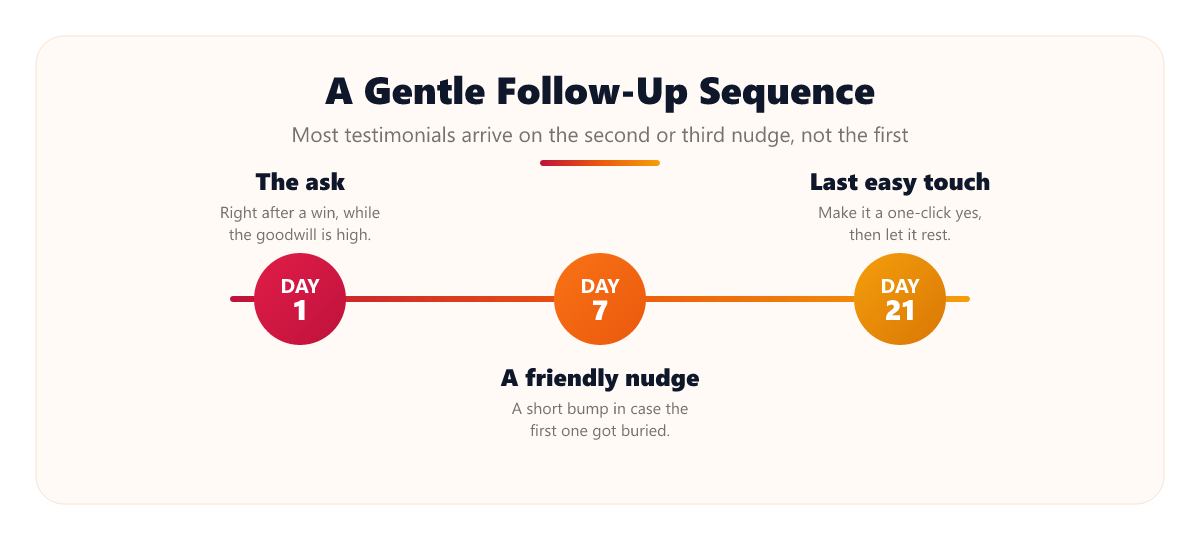
Most reviews land on the second touch, not the first. A single, gentle reminder a few days later (“just floating this back to the top of your inbox”) recovers a surprising number of responses. One nudge is helpful; three is nagging.
The best channels for review requests
The right channel is usually the one the customer already uses to talk to you. Here is how the main options compare.
| Channel | Best for | Why it works |
|---|---|---|
| Most businesses, B2B, considered purchases | Room to personalize and include a clear link; easy to automate and track | |
| SMS | Local services, restaurants, mobile-first customers | Near-instant open rates; perfect for a same-day ask with one link |
| In person | Trades, clinics, salons, retail | Highest trust; pair the verbal ask with a QR code or follow-up text |
| In-app or post-checkout | SaaS and e-commerce | Catches the customer at the moment of value, in context |
| QR code | Physical locations and packaging | Turns a counter, receipt, or box into a one-tap review link |
Whatever channel you choose, the principle is the same: meet customers where they already are and hand them the shortest possible path to the review.
Where should you send people to review you?
The right platform depends on your industry and your goal. Sending every customer to the single site that matters most for you concentrates your social proof where it counts, instead of scattering a few reviews across a dozen profiles.
- Local and service businesses: Google is almost always the priority because it shows up in Maps and local search. Add Yelp or your industry's main directory as a secondary.
- Software and B2B: G2, Capterra, and TrustRadius are where buyers compare tools, so reviews there influence purchase decisions directly.
- E-commerce: on-site product reviews plus a trust platform like Trustpilot tend to do the most work.
- Hospitality and travel: Google, TripAdvisor, and the booking platform you depend on.
If you are not sure which profiles deserve your attention, our roundup of the best customer review sites by industry maps the major platforms to the businesses that benefit most from each.
Review request templates you can copy
Steal these and swap in your details. Keep them short, specific, and link-first.
Email template (after a delivered result)
Subject: Quick favor, [First name]?
Hi [First name], it was a pleasure helping you [specific project or result]. Reviews are how most new clients find us, so if you have two minutes, would you mind sharing your experience here: [direct link]? Even a few sentences about [the problem you solved] would help enormously. Thank you either way, and let me know if you ever need anything.
SMS template (same-day, local service)
Hi [First name], thanks for choosing [Business] today! If you were happy with the [service], a quick Google review would mean a lot: [short link]. Takes about 30 seconds. Thank you!
In-person script
“I'm really glad you're happy with how this turned out. If you have a second, a short Google review genuinely helps people in the area find us. I can text you the link right now so it's easy, would that be okay?”
Post-purchase (e-commerce)
Subject: How is your [product] working out? Hi [First name], now that you have had a few days with your [product], we would love to hear what you think. A quick review here [link] helps other shoppers buy with confidence, and it helps us keep improving. Thanks for being a customer.
After a support ticket is resolved
Hi [First name], glad we got [specific issue] sorted. If the support experience was a good one, would you mind saying so here? [link] It takes about a minute and it genuinely helps the team. Either way, thanks for your patience while we fixed it.
A resolved ticket is one of the most underused moments in the whole list. The customer had a problem, you fixed it, and gratitude is at its peak. Send it from the person who handled the ticket, not from a shared inbox.
Social media DM
Hey [First name], saw your post about [specific thing they said] and it made our day. If you have a spare minute, would you drop that in a review here? [link] No worries at all if not.
Only send this to someone who has already said something positive in public. A cold DM asking for a review reads as spam. Referencing their exact words is what makes it land.
QR code (in person)
Printed beside the code: Was today good? Tell us in 30 seconds. Scan, tap, done. No app, no account.
For restaurants, clinics, retail, events, and trades. Put the code where the customer is already stationary and satisfied: the receipt, the table, the invoice, the badge. Two rules decide whether it works. It must open straight into a mobile page with no login, and the printed line must be readable while standing up. Hand it over with a spoken sentence rather than leaving it to be noticed.
Automated post-milestone request
Subject: You just hit [milestone]
Hi [First name], you have now [specific milestone: shipped 100 orders, completed your third project, been with us a year]. That is worth marking.
If it has been a good experience, would you leave a short review? [link] One minute, and it helps people in the same position work out whether this is for them.
Trigger on a behaviour that signals success, never on a date since signup. "You have been a customer for 30 days" tells you nothing about whether they are happy; "you completed your third project" does. Suppress the automation for anyone with an open support ticket or a recent complaint.
The single follow-up
Hi [First name], just floating this back to the top of your inbox in case it got buried. If you would still be up for leaving a review, the link is here: [link] If not, no problem at all and I will not chase it again.
Send once, three to five days after the original, and mean the promise not to chase again. A single follow-up typically recovers a meaningful share of non-responses; a second one costs goodwill for very little return.
The incentivised ask, done legitimately
Hi [First name], we are giving everyone who shares feedback this month a [small perk]. To be clear, the perk is for the feedback, not for a good rating, so please be honest. Here is the link: [link]
Handle this one carefully. Google's policies prohibit offering incentives in exchange for reviews on Google, and the FTC's rules in the US treat incentives conditioned on positive sentiment as deceptive. Two conditions make an incentive defensible: it is offered for feedback regardless of what the feedback says, and it is offered to everyone rather than only to customers you expect to be happy. If the incentive is contingent on a five-star rating in any way, do not run it. Safer still, use incentives for testimonials on your own site and keep third-party review requests unincentivised.
If your goal is a polished email sequence rather than a single send, we have a deeper library in our guide to the testimonial request email templates that actually get replies, and a set of testimonial questions to ask your clients that work just as well as review prompts.
How to ask for Google reviews specifically
Google reviews deserve special attention because they do double duty: they build trust and they feed your local search ranking. The mechanics are simple. From your Google Business Profile you can generate a short review link or QR code, then put it everywhere it makes sense, in email signatures, on receipts, on a counter card, and in your post-service text.
Two rules keep you safe and effective. First, never gate the ask (do not ask only happy customers, which violates Google's policy); ask everyone and let the quality of your work do the filtering. Second, respond to every review you receive, positive or negative. We cover the ranking mechanics in detail in how Google reviews impact your local SEO.
Mistakes that quietly kill your review rate
- Asking too late. Waiting weeks lets the emotion cool and the details blur.
- Burying the link. If the customer has to search for where to go, most will not.
- Asking for too much. A long form or a five-paragraph request reads like homework.
- Paying for reviews. It undermines trust and breaks the rules of most platforms. Offer thanks, not payment.
- One and done. Skipping the single follow-up leaves easy reviews on the table.
- Ignoring the reviews you get. No response signals you are not listening, which discourages the next person.
A simple 30-day plan to get your first 25 reviews
If you are starting close to zero, structure beats willpower. Here is a four-week plan that builds momentum without feeling like a campaign.
- Week 1: set the foundation. Pick your primary platform, generate a direct review link and a QR code, and add the link to your email signature and your invoice or receipt template. Draft the three templates above.
- Week 2: mine your recent happy customers. List everyone from the last 60 days who had a clearly positive experience. Send each a personalized request on the channel they already use with you. This back-catalog is the fastest source of early reviews.
- Week 3: follow up and go live with the habit. Send one gentle reminder to anyone who has not responded. Start asking new customers automatically at the moment of value, so the pipeline keeps filling itself.
- Week 4: respond and showcase. Reply to every review you have collected, then pull your strongest ones onto your website so they keep working long after they are posted.
Twenty-five reviews in a month is realistic for most businesses with an existing customer base, and by the end of it you have a repeatable system rather than a one-off effort.
How to automate review requests without losing the human touch
Doing all of this by hand works until you have more than a handful of customers. Then it gets inconsistent, and inconsistency is why most review pipelines dry up. The fix is a light system that triggers a personalized request at the right moment, follows up once automatically, and routes the response where it belongs.
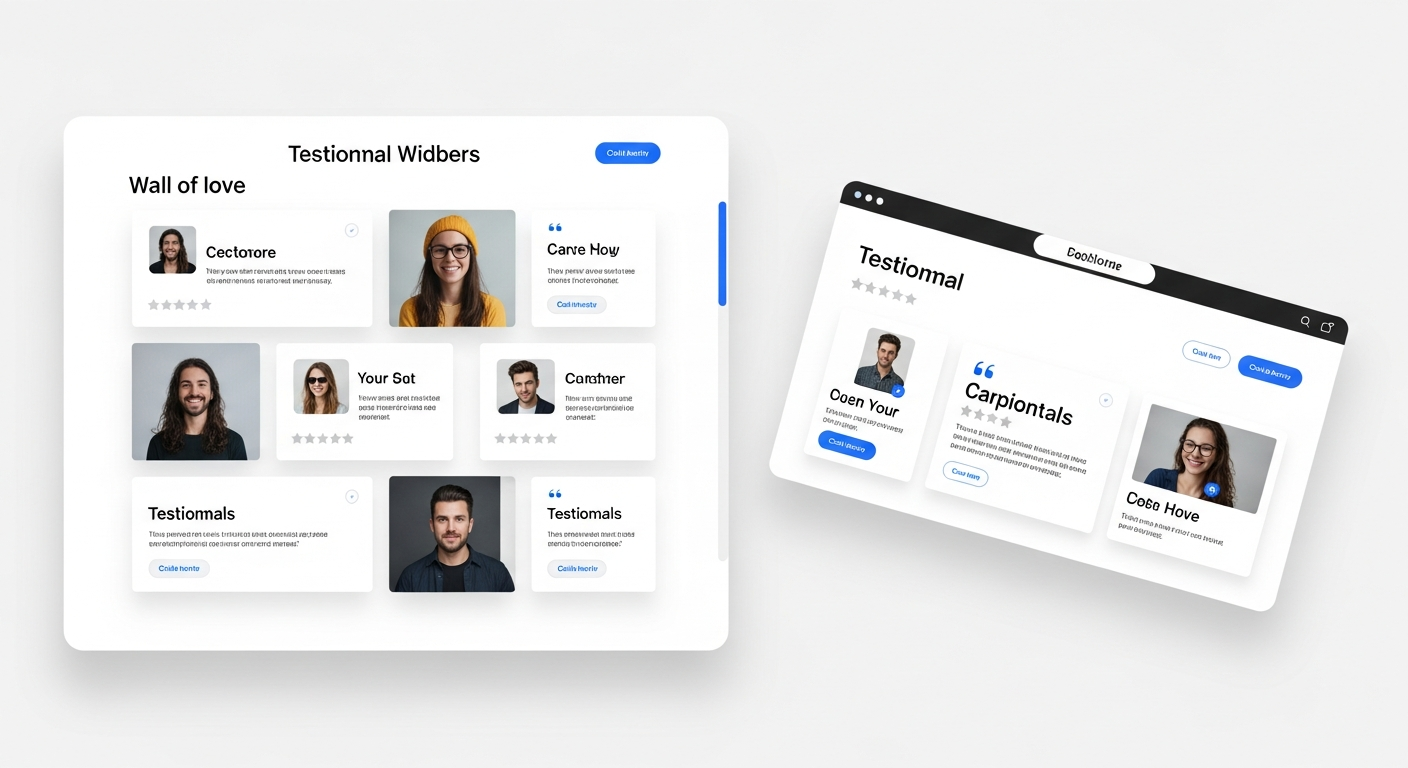
That is exactly what Prooflet is built for. You can send branded requests by email or link, let customers reply with a written quote or a video testimonial, automate the follow-up, and then publish the best responses on your site as a Wall of Love or embeddable widget. The same flow that collects testimonials for your website can prompt customers toward public review platforms, so one habit feeds both. When you are ready to put it on autopilot, our guide to getting customer testimonials walks through building the repeatable habit step by step.
Get the timing and the ask right, make it effortless, and follow up once. Do that consistently and reviews stop being something you chase and start being something that simply happens.
Frequently asked questions
How do I politely ask for a review?
Thank the customer, reference the specific work you did together, make a small and explicit request, and include a direct link. A line like “it was a pleasure helping with [project]; if you have two minutes, a short review here [link] would mean a lot” is polite, clear, and easy to act on.
When should I ask a customer for a review?
Ask within a day or two of a clear win: a delivered project, a solved problem, a product that arrived and worked, or a positive support interaction. Asking at a peak moment of satisfaction gets more responses and more detailed reviews.
Can I offer an incentive for a review?
You can thank customers for honest feedback with a small token, but never pay for a review or condition it on a positive rating. Most platforms, including Google, prohibit incentivized or gated reviews, and it erodes the trust that makes reviews valuable.
How many times should I follow up?
Once. Most reviews come on the second touch, so a single gentle reminder a few days after the first ask recovers many responses. Beyond one follow-up you risk annoying the customer for little extra gain.
What is the difference between a review and a testimonial?
A review is public feedback on a third-party platform you do not control, such as Google or Trustpilot. A testimonial is a quote you request and feature on your own website. You want both: reviews for independent credibility and search visibility, testimonials for curated social proof on your pages.
How do I ask for a review in person?
Ask at the moment the customer expresses satisfaction, hand them a QR code that opens straight to the review page with no app or login, and say one sentence about why it helps. Do not ask at the till before the outcome is clear.
Should I automate review requests?
Yes, but trigger on a success behaviour rather than a date. “Completed a third project” signals a happy customer; “30 days since signup” signals nothing. Always suppress the automation for anyone with an open support ticket or a recent complaint.