How to Get Customer Testimonials: 9 Methods That Work
Updated

On this page
- Why the Usual Approach Falls Flat
- 9 Methods to Get Customer Testimonials
- 1. A Well-Timed Email Follow-Up
- 2. In-Person Requests During Meetings
- 3. Text Message Requests
- 4. Social Media Engagement
- 5. Testimonial Swaps
- 6. Thoughtful Incentives
- 7. Automated Follow-Up Sequences
- 8. Mine Your Existing Feedback
- 9. Convert Case Studies Into Quotes
- Pick Two or Three, Not All Nine
- More Channels Worth Trying
- Put Your Testimonials to Work
- Make It a System With Prooflet
- Frequently Asked Questions
You finish a project, the client is thrilled, and they say the words every business loves to hear: I will definitely send people your way. Then you ask for a testimonial and the thread goes quiet. Sound familiar?
Quick answer: To get customer testimonials: (1) ask within 48 hours of a positive interaction, while the detail is still fresh, (2) use guided prompts rather than open-ended questions, (3) offer video, text, and audio options in the same form, (4) make it one click with a branded form that needs no customer account, and (5) automate the request at key milestones. The two prompts that produce the most usable answers are "What problem did we solve?" and "What specific results did you get?"
Here is the thing: the silence is almost never about willingness. Surveys consistently show that the large majority of satisfied customers are happy to recommend you. The problem is the ask itself, usually the timing or the amount of effort it demands. Fix those, and testimonials start showing up. Below are nine methods that work, plus how to time them and follow up without being annoying.
Why the Usual Approach Falls Flat
The most common mistake is using one script for everyone. A SaaS founder lives in their inbox and will happily click a form link. A contractor or a manufacturer might never reply to email but will give you a glowing quote on a two-minute phone call. A long-time client who texts you about everything will find a formal email request oddly stiff.
So before you pick a tactic, ask a simpler question: how does this customer already talk to me? Match the request to their natural channel and the response rate climbs on its own.
9 Methods to Get Customer Testimonials
1. A Well-Timed Email Follow-Up
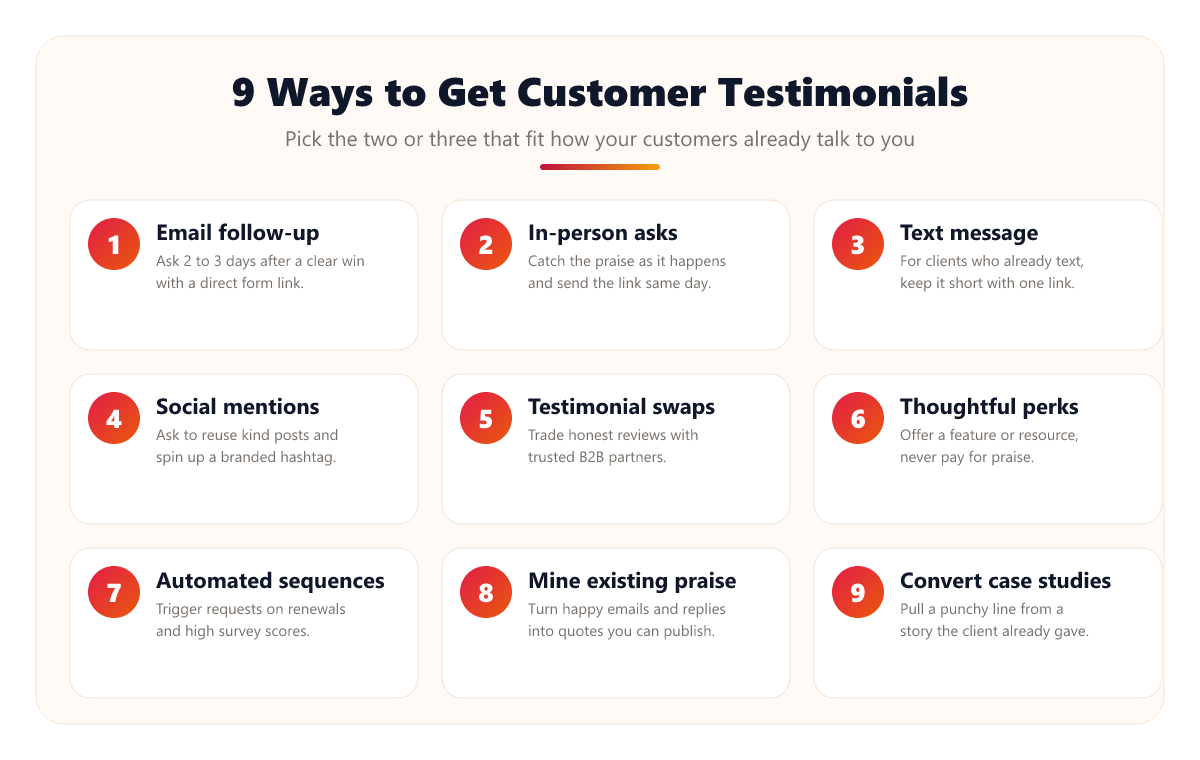
Email is still the backbone of testimonial collection. The trick is timing: send your request two to three days after a clear win, a delivered project, a great result, or a piece of positive feedback. Tie the ask to that moment (“so glad the launch went well”), keep it to a sentence or two, and include a direct link so they never have to wonder where to reply.
2. In-Person Requests During Meetings
When a client says something genuinely kind to your face, that is the moment, not next quarter. A simple “that means a lot, would you be open to sharing that as a testimonial?” works because the emotion is real and present. Follow up the same day with a link while it is still fresh, rather than waiting for some perfect future time that never comes.
3. Text Message Requests
If a client already texts you, a text request feels natural instead of intrusive. Keep it extremely short and drop in a single link. The familiarity of the channel removes friction, and a quick text often gets a reply faster than an email that sits unread for a week.
4. Social Media Engagement
Your customers are already saying nice things in public. Keep an eye on mentions and tags, and when someone posts something kind, ask permission to feature it. You can also create a simple branded hashtag that invites customers to share their experience, which turns into a steady, low-effort stream of proof over time.
5. Testimonial Swaps
If you work in B2B, some of your best sources are peers you already trust. Offer to write an honest testimonial for a partner or vendor in exchange for one in return. Done genuinely, it is a fair trade that benefits both businesses and tends to produce specific, credible quotes because each side actually knows the other's work.
6. Thoughtful Incentives
Incentives can nudge people who are willing but busy, as long as you do it carefully. Avoid paying directly for praise, which undermines trust and crosses advertising guidelines. Instead, offer something of value: a free audit, access to a useful resource, a spot in a featured case study, or entry into a small giveaway. Always ask for honest feedback and disclose any incentive when you publish.
7. Automated Follow-Up Sequences
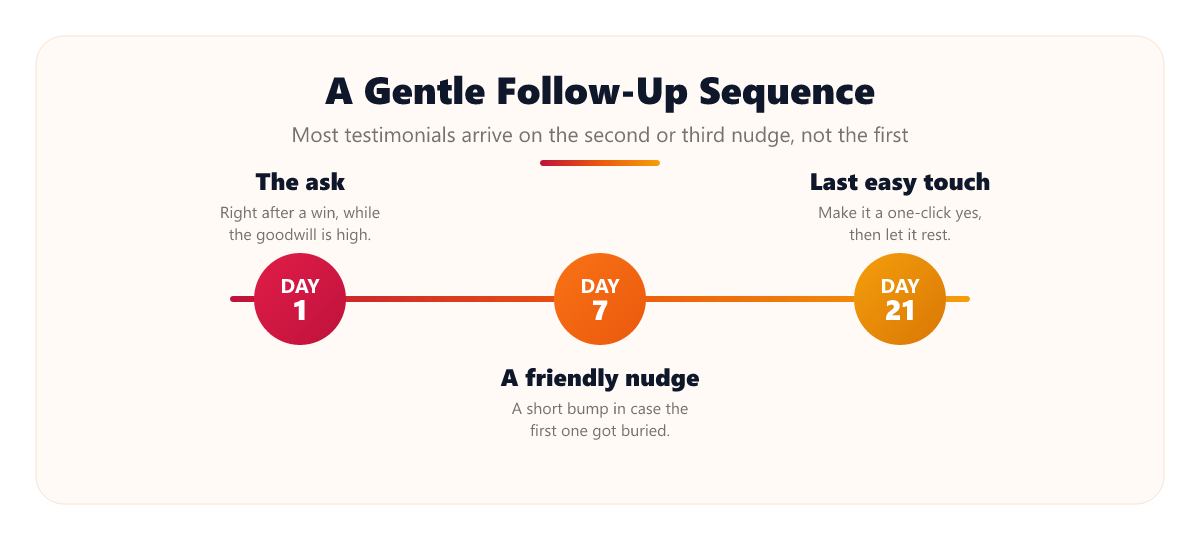
Relying on memory is why most testimonial libraries go stale. Set up a simple sequence that triggers at the right moments, the end of a project, a high survey score, or a renewal, and follows up gently if there is no reply. A light cadence of three touches (day 1, day 7, day 21) catches the people who meant to respond and forgot, without ever feeling like nagging.
8. Mine Your Existing Feedback
Some of your best testimonials already exist, buried in your inbox. A thank-you email, a five-star survey comment, or a kind note in a support ticket is a testimonial waiting for permission. Reach out, quote their own words back to them, and ask if you can feature it. Because the sentiment is already there, these convert far more easily than a cold request.
9. Convert Case Studies Into Quotes
If you have run a detailed case study with a client, you are sitting on testimonial gold. The customer is already invested and clearly happy, so pulling one or two punchy lines into a standalone quote takes almost no extra effort from them. One rich case study can yield several short testimonials for different pages.
Pick Two or Three, Not All Nine
You do not need to run every method at once. Trying to do all nine usually means doing none of them well. Look at how your customers actually communicate, choose the two or three channels that fit, and build a simple repeatable habit around them. Consistency beats variety every time.
More Channels Worth Trying
The nine methods above cover most situations, but depending on your business a few other channels are worth adding to the mix:
- Post-purchase surveys: a short survey right after a purchase or onboarding catches the experience while it is fresh, and a strong open-ended answer often reads like a ready-made testimonial.
- Website capture forms: a simple submission page on your site lets happy customers leave a quote or video whenever the mood strikes, with no back-and-forth.
- Online review links: after a clearly positive moment, point customers to Google or an industry platform with a direct link or QR code, then repurpose the best reviews on your own site.
- User-generated content: encourage customers to post about your product with a branded hashtag, then ask permission to feature the best posts.
For the exact wording of each ask, see our guide on how to ask for testimonials without being awkward and our ready-to-use testimonial request email templates. Not sure what customers should talk about? Start with these testimonial questions to ask your clients.
Put Your Testimonials to Work
Collecting testimonials is only worth it if people see them. Place your strongest quotes where decisions happen: the homepage hero, specific service or product pages, and right before checkout or contact forms. Then multiply each one, a single great testimonial can become a social post, an email signature line, a slide in a sales deck, or part of a video compilation. Video testimonials, in particular, tend to convert better than text alone, so prioritize it for your happiest customers.
Make It a System With Prooflet
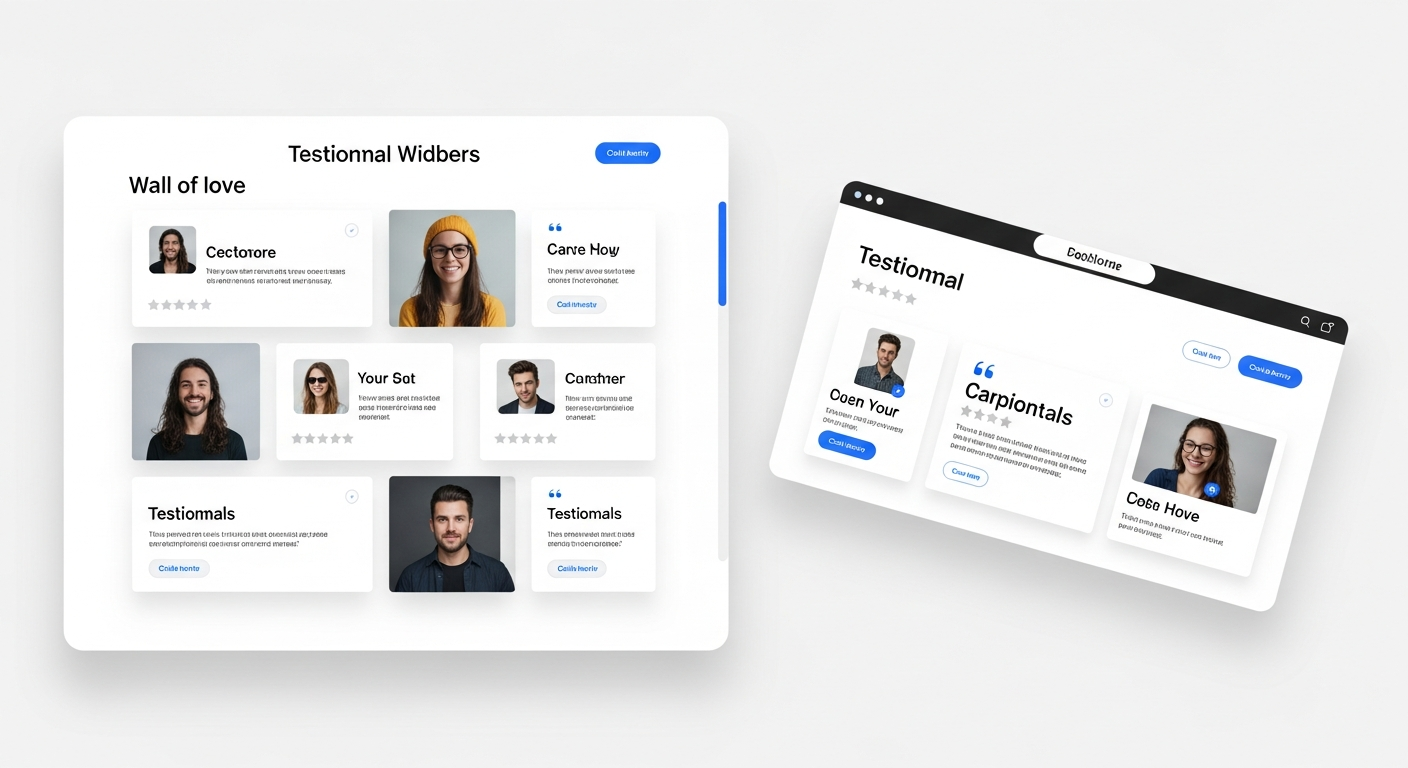
Doing all of this by hand gets old fast. Prooflet handles the whole loop for you: send branded requests by email, let customers reply with text or video on a friction-free page, automate the follow-up sequence, and then display the best responses in a Wall of Love or an embeddable testimonial widget. If you are chasing testimonials manually today, automating the routine parts is the fastest way to get more of them.
Frequently Asked Questions
1. How do I ask customers for testimonials?
Send a personalized request after a milestone: project completion, positive support interaction, or subscription renewal. Use guided prompts so customers know what to say.
2. When is the best time to ask for a testimonial?
Right after a customer feels real value: a completed project, a strong result, a milestone, or a great support experience. Asking within 48 hours of a peak moment gets more responses and more specific, enthusiastic answers.
3. Should I use video or text testimonials?
Both. Video converts roughly twice as well because viewers see real emotion, but text is faster and easier for customers to give. Offer both options in a single form and let the customer choose.
4. How many testimonials should I start with?
Aim for five to ten strong, specific testimonials to begin with. That is enough to build credibility across your key pages. Quality and detail matter far more than sheer volume, so focus on getting a handful of great ones before worrying about quantity.
5. Should I pay customers for testimonials?
No. Paying directly for praise damages authenticity and can run afoul of advertising rules. If you want to offer something, make it a thank-you for honest feedback, such as a useful resource or a small perk, and disclose the relationship when you publish.
6. Can I edit a testimonial before publishing?
Light edits for typos and clarity are fine, but never change the meaning or tone. Always send the final version back to the customer for approval before it goes live.
7. What if a customer gives critical feedback instead?
Treat it as a gift. Critical feedback shows you exactly what to improve, and customers who feel heard often become your strongest advocates later. Fix the issue, follow up, and the testimonial may come on its own.
8. Can I reuse a public review as a testimonial?
Yes, with proper attribution. A positive Google or G2 review can be featured on your site, ideally with the reviewer's name and a link to the original. When in doubt, a quick note asking permission keeps everything above board.