Good Review Examples and Templates for Every Industry
Updated
On this page
- What makes a review actually good?
- Good review examples by industry
- Restaurant review examples
- Hotel and hospitality review examples
- E-commerce and product review examples
- SaaS and software review examples
- Doctor and healthcare review examples
- Real estate review examples
- Salon and personal care review examples
- Online course and coaching review examples
- Agency and consultant review examples
- Home services and contractor review examples
- Automotive review examples
- Gym and fitness review examples
- Legal review examples
- Travel and short-term rental review examples
- Dental review examples
- B2B and manufacturing review examples
- Weak vs strong: the same review, upgraded
- How to write or structure a strong review
- Review request templates by industry
- Local service request
- E-commerce post-purchase request
- SaaS milestone request
- Professional services request
- How to respond to positive reviews
- Positive review response templates
- Video review examples and why they convert
- Common mistakes that make reviews fall flat
- How to encourage more customers to leave reviews
- Turn these examples into your own reviews
- Frequently asked questions
- What does a good review look like?
- Can I write reviews for my customers to copy?
- How should I respond to a positive review?
- What are the best questions to prompt a good review?
- Where should I display my best reviews?
A great review does something a brochure never can: it lets a stranger borrow the confidence of someone who already took the risk. But not all reviews are created equal. “Great service, highly recommend” is pleasant and almost useless. A review that names the problem, the result, and the moment it clicked can close a sale on its own.
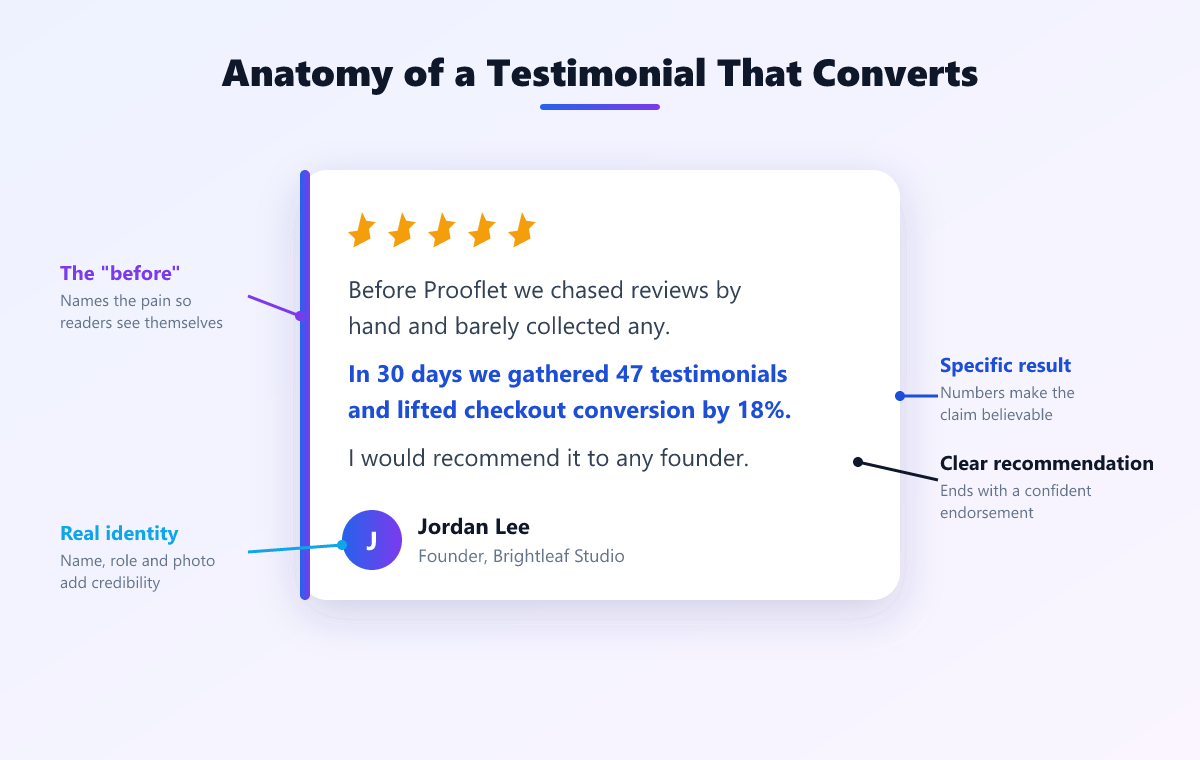
Quick answer: A good review is specific, written in plain human language, and structured around a before and after. The most persuasive ones name the problem the customer had, the concrete result they got (ideally with a number), why it mattered, and end with a clear recommendation, all attributed to a real, named person.
Below you will find what separates a strong review from a forgettable one, dozens of examples across industries you can use as models, and ready-to-use templates for both collecting reviews and responding to them. For the broader picture of how reviews fit alongside curated quotes, see our explainer on what a testimonial is, with real examples.
What makes a review actually good?
Look closely at any review that made you want to buy and you will find the same ingredients. These are the parts to look for, and to prompt your customers toward.
- A clear before. It names the problem or hesitation the customer started with, so readers recognize their own situation.
- A specific result. “Saved us a full day a week” beats “really helped” every time. Numbers and concrete details make a claim believable.
- Plain language. Real people do not talk in marketing slogans. The slightly imperfect, human phrasing is what makes it ring true.
- A genuine recommendation. A confident closing line gives the reader permission to say yes.
- A real identity. A full name, role, location, and photo turn an anonymous quote into a person you can trust.
Keep those five in mind as you read the examples. You will see them again and again.
Good review examples by industry
These are written the way real customers talk: short, specific, and grounded in a real experience. Use them as templates for the kind of feedback worth asking for, not as text to copy.
Restaurant review examples
“We came in for an anniversary dinner with low expectations on a Tuesday and left planning our next visit. The server suggested the special without being pushy, the pasta was clearly made in house, and they quietly brought out a little dessert when they heard we were celebrating. Easily our new neighborhood spot.”
“Fast, friendly, and the portions are honest. I ordered delivery during a hectic work night and it arrived hot and exactly right, no missing items. For the price, the quality genuinely surprised me.”
Why they work: both name a specific occasion or situation and a concrete detail (the house-made pasta, the complete order) instead of vague praise.
Hotel and hospitality review examples
“The room photos did not do it justice. Spotless, quiet, and a five-minute walk from everything we wanted to see. The front desk remembered our names by the second day and booked us a last-minute dinner reservation we could not get ourselves.”
“We travel with two small kids, which usually means stress. This hotel had a crib waiting, a kettle in the room, and staff who genuinely did not mind the chaos. It is rare to feel this welcome.”
Why they work: they speak to a specific traveler (a couple sightseeing, a family with kids), which lets similar readers see themselves in the story.
E-commerce and product review examples
“I ordered a size up like the reviews suggested and the fit was perfect. It arrived two days early, and the fabric feels far more premium than the price would suggest. Already bought a second one in another color.”
“I was nervous about buying a mattress online without trying it, but the trial period sold me. Three weeks in and my back pain is noticeably better. Setup took ten minutes and the old-mattress haul-away was free.”
Why they work: they address the exact hesitation an online shopper feels (sizing, buying unseen) and resolve it with a specific outcome. For more on placing these well, see our guide to testimonials for ecommerce.
SaaS and software review examples
“Onboarding three new hires used to eat a full week. With this tool we do it in an afternoon, and the dashboard actually tells us what is happening instead of making us guess. The support team replied to my setup question in under an hour.”
“I was skeptical a team as small as ours could pull this off, but we were live over a weekend. Three months later it is the first tool everyone opens in the morning.”
Why they work: they lead with a measurable before and after (a week down to an afternoon) and the kind of detail a competitor could never invent. Software buyers read exactly this way, which we explore in testimonials for SaaS.
Doctor and healthcare review examples
“I put off this procedure for a year because I was scared. The team walked me through every step, answered questions I felt silly asking, and even called the next day to check on me. My only regret is not coming in sooner.”
“The wait was short, the doctor did not rush me, and for the first time I left an appointment actually understanding my treatment plan. The front-desk staff handled my insurance without me having to chase anything.”
Why they work: healthcare reviews convert on reassurance. These highlight communication, patience, and follow-up, the exact anxieties patients carry in.
Real estate review examples
“We were relocating across the country with two kids and a hard deadline. Our agent found us a home in nine days and quietly handled the parts that usually keep buyers up at night. She negotiated below asking and flagged an issue the inspector almost missed.”
“As first-time sellers we had no idea what we were doing. He priced the house realistically, staged it on a budget, and we had three offers in a weekend. Calm, honest, and always reachable.”
Why they work: they prove local expertise and the ability to manage a stressful, high-stakes transaction. Our guide to real estate testimonials covers how agents collect these.
Salon and personal care review examples
“I brought in a photo half-expecting the usual gap between hope and reality. She actually listened, explained what would and would not work with my hair, and nailed it. First time in years I have left a salon genuinely happy.”
“Booking was easy, they ran on time, and the head massage during the wash alone was worth the visit. I have already rebooked for next month.”
Why they work: they capture the emotional payoff of a personal service and a specific detail that makes the experience tangible.
Online course and coaching review examples
“I have bought a graveyard of courses I never finished. This one was different: short, practical lessons and an actual community. I landed my first two freelance clients before I even finished module four.”
“My coach helped me stop spinning my wheels. We set one clear goal a week, and within two months I had doubled my rates and stopped working weekends. Worth every penny.”
Why they work: they name a concrete result (clients landed, rates doubled) that the next buyer wants for themselves. See testimonials for course creators for collection tactics.
Agency and consultant review examples
“We hired them to untangle a messy rebrand and ended up with a system the whole team understands. They showed up on time, explained everything in plain English, and the new site lifted our demo bookings by a third in the first month.”
“Most consultants hand you a deck and disappear. This one sat with our team, implemented alongside us, and stayed reachable after the engagement ended. Genuinely felt like a partner, not a vendor.”
Why they work: they signal reliability, clear communication, and a measurable business result, the things B2B buyers screen for. More in testimonials for agencies and testimonials for consultants.
Home services and contractor review examples
“Three other companies ghosted me after quoting. These folks showed up when they said, gave a fair price in writing, and cleaned up so well you would never know they had been here. The new water heater has been flawless for six months.”
“I expected the usual upsell and got honest advice instead. He told me the repair was cheaper than a replacement and walked me through how to maintain it. I will never call anyone else for plumbing.”
Why they work: they hit the homeowner's biggest fears, no-shows, surprise costs, and mess, and resolve each one specifically.
Automotive review examples
“No pressure and no surprise charges. The salesperson laid out every number up front, let me take my time, and the car has been flawless for 20,000 miles. The follow-up call a week later sealed it.”
“I brought my car in dreading a huge bill and they found it was a simple fix under warranty. Honesty like that earns a customer for life.”
Why they work: car buyers brace for pressure and hidden fees, so transparency and honesty stand out the most.
Gym and fitness review examples
“I had not exercised in years and was intimidated walking in. The trainer met me where I was, built a plan around a bad knee, and six weeks later I am genuinely looking forward to sessions. No judgment, just support.”
“Clean equipment, classes that start on time, and staff who actually learn your name. It feels like a community, not a contract I am trying to escape.”
Why they work: they speak to the emotional barrier (intimidation) and the small operational details that make a gym sticky.
Legal review examples
“I was anxious about the whole case, but my attorney replied to every email within hours and never made a single question feel silly. She explained my options in plain language and the outcome was better than I hoped.”
“Clear pricing, no jargon, and steady communication throughout. For something this stressful, feeling informed at every step made all the difference.”
Why they work: legal clients are anxious, so reviews that highlight responsiveness, plain language, and reassurance carry real weight.
Travel and short-term rental review examples
“The listing was honest, which is rarer than it should be. Everything matched the photos, check-in was a breeze with the lockbox, and the host left a little guide to their favorite local spots that made the trip. Spotless and quiet.”
“We had a late-night travel hiccup and the host responded within minutes to sort it out. That kind of care turns a one-time stay into a place we will book again.”
Why they work: travelers fear the gap between listing and reality, so accuracy and responsiveness are exactly what reassure the next guest.
Dental review examples
“I am genuinely phobic about the dentist and put off a visit for years. They never rushed me, explained each step before it happened, and offered options instead of a lecture. I actually booked my next cleaning before I left.”
“Transparent pricing, almost no wait, and the hygienist was gentle and thorough. They sent a reminder and handled my insurance paperwork without me lifting a finger.”
Why they work: they address dental anxiety and the practical frustrations (cost, waiting, paperwork) in one specific story.
B2B and manufacturing review examples
“Our previous supplier was a constant source of delays. These folks hit every deadline for a year straight, flagged a spec issue before it became a problem, and their account manager actually picks up the phone. Reliability like this is worth a premium.”
“We needed a custom run on a tight timeline and they delivered without cutting corners. Quality was consistent across every unit, and the documentation was flawless for our audit.”
Why they work: B2B buyers screen for reliability and risk reduction, so reviews that prove consistency and proactive communication land hardest.
Weak vs strong: the same review, upgraded
The fastest way to understand a good review is to watch a weak one become strong. The content is the same; the specifics are what change.
Weak: “Great service, very professional. Highly recommend!”
Strong: “I needed a logo and brand kit in under two weeks for a launch, and assumed that was impossible on my budget. They delivered early, nailed the brief on the second round, and the new branding got more compliments in a week than my old one did in two years. If you are a founder on a deadline, start here.”
The weak version could describe any business on earth. The strong version names the deadline, the constraint, the result, and the exact reader it is for. When you ask for reviews, a couple of guiding prompts are what move customers from the first kind to the second.
How to write or structure a strong review
If a customer asks what to say, give them a simple frame. It removes the blank-page problem and produces far better reviews.
- Set the scene. What was going on, and what problem or hesitation did you have?
- Describe what happened. What did the business do, and what stood out?
- Share the result. What changed, ideally with a specific detail or number?
- Make a recommendation. Who would you tell to use this, and why?
That structure maps directly to the questions that produce the best feedback, which we collect in our list of testimonial questions to ask your clients.
Review request templates by industry
To get reviews like the ones above, you have to ask well. Here are short request templates you can adapt. For the full timing and channel strategy, see how to ask for a review.
Local service request
Hi [First name], it was a pleasure helping with [job] today. If you were happy with how it turned out, a quick Google review would genuinely help other people in [area] find us: [link]. Even a sentence or two makes a difference. Thank you!
E-commerce post-purchase request
Hi [First name], now that you have had your [product] for a few days, we would love to know what you think. A short review here [link] helps other shoppers buy with confidence. Bonus points for a photo!
SaaS milestone request
Hi [First name], congrats on [milestone, e.g. your first 100 records imported]! If [product] has been useful, would you share a quick review on [platform]? [link]. It helps other teams decide, and it means a lot to ours.
Professional services request
Hi [First name], I really enjoyed working with you on [project]. If you have two minutes, a short review about your experience would help future clients know what to expect: [link]. No pressure at all, and thank you either way.
How to respond to positive reviews
Responding to good reviews is not just courtesy; it encourages the next reviewer and adds fresh, relevant text to your profile. Keep replies short, specific, and human.
- Thank them by name. A generic reply reads like a bot.
- Reference a specific. Echo a detail they mentioned to show you actually read it.
- Reinforce the value. A light line about what you care about lands well with future readers.
- Invite them back. A warm, low-key open door encourages a repeat visit.
Positive review response templates
“Thank you, [First name]! We are so glad the [specific thing] worked out, and it was a pleasure working with you. We are always here if you need anything down the road.”
“This made our day, [First name]. [Team member] will be thrilled to hear the [detail] stood out. Thanks for taking the time, and we hope to see you again soon.”
For the other side of the coin, when a review is critical, our guide on how to respond to negative reviews has templates and phrases to avoid.
Video review examples and why they convert
Written reviews are the workhorse, but a video review carries something text cannot: a real face, a real voice, and unmistakable authenticity. You cannot fake the relief in someone's tone when they describe a problem finally solved. Video reviews tend to be the most persuasive format precisely because they are the hardest to fabricate.
You do not need anything polished. The most effective video reviews sound like these, just spoken instead of typed:
“Hi, I am Maria, I run a small bakery. I was drowning in spreadsheets until I found this. Now ordering takes ten minutes a week and I actually have my evenings back. If you run a food business, just try it.”
“I am a freelance designer and I was nervous about raising my rates. My coach talked me through it, and three clients later nobody blinked. I cannot recommend her enough.”
The structure is identical to a strong written review: a before, a specific result, and a recommendation. The difference is that a camera makes it impossible to doubt. Collecting them is easier than most people expect; our video testimonial software lets customers record straight from a link, no app or account required.
Common mistakes that make reviews fall flat
- Settling for vague praise. “Great service” is forgettable. A guiding prompt turns it into a specific story.
- Asking too late. The detail and emotion fade fast; ask while the experience is fresh.
- Hiding the identity. An anonymous quote is far weaker than one with a name, role, and photo.
- Never responding. Reviews left without a reply signal that no one is listening.
- Leaving them on one platform. A great review trapped on a single profile reaches a fraction of its potential audience.
How to encourage more customers to leave reviews
Even great service does not guarantee reviews. You have to make asking a habit:
- Ask at the peak moment, right after a clear win.
- Send a direct link, ideally to one chosen platform, with zero friction.
- Follow up once; most reviews arrive on the second nudge.
- Offer prompts, not scripts, so customers know what to talk about.
- Showcase the reviews you get, which quietly encourages others to add theirs.
To decide where to send people, our roundup of the best customer review sites by industry maps the platforms that matter most for your business.
Turn these examples into your own reviews
Reading great reviews is one thing; collecting your own consistently is another. The businesses with walls of specific, recent reviews are not luckier, they have a system: ask at the right time, make it effortless, follow up, and display the results.
That is what Prooflet handles end to end. Send a branded request, let customers reply with a written quote or a video testimonial on a simple page, then publish your strongest responses as a Wall of Love or embeddable widget on your site. The same prompts that produce the examples above can run automatically, so good reviews stop being something you hope for and become something you reliably collect. When you are ready to build the habit, our guide on how to get customer testimonials lays out the full system.
Frequently asked questions
What does a good review look like?
A good review is specific and human. It names the problem the customer started with, describes what the business did, shares a concrete result (ideally with a detail or number), and ends with a clear recommendation, all attributed to a real, named person. Vague praise like “great service” is far less persuasive than a short, specific story.
Can I write reviews for my customers to copy?
No. Reviews must be the customer's own honest words; fabricated or copied reviews violate platform policies and read as fake. Instead, give customers a simple structure or a few prompt questions so they find it easy to write a genuine review in their own voice.
How should I respond to a positive review?
Thank the reviewer by name, reference a specific detail they mentioned, briefly reinforce what you care about, and invite them back. Keep it short and human; generic replies read like automation and do little for the readers who follow.
What are the best questions to prompt a good review?
Ask what problem they were trying to solve, what stood out about working with you, what result they got, and who they would recommend you to. These questions guide customers toward the specific, story-driven detail that makes a review convincing.
Where should I display my best reviews?
Put them where decisions happen: your homepage, your product or service pages, and near checkout or contact forms. Displaying reviews on your own site with a tool like Prooflet keeps your strongest proof in front of buyers instead of leaving it on a third-party profile.