
What Makes a Good Testimonial? The 3 Rules (And Best Format)
Updated
On this page
- The 3 rules of a good testimonial
- Rule 1: It is specific
- Rule 2: It is attributed to a named person
- Rule 3: It describes a result, not a feeling
- The best format: 5 parts
- How long a testimonial should be
- Text vs video vs audio testimonials
- What to include in each format
- How good testimonials go wrong
- Collect testimonials that follow the rules
- Frequently Asked Questions
A testimonial needs three things to work: it must be specific, attributed to a named person, and focused on a result rather than a feeling. Everything else, including length, format, and media type, follows from those three.
In short: good testimonials follow 3 rules (specific, attributed, result-focused) and a 5-part format: who, problem, action, result, recommendation. Written testimonials run 40 to 80 words; video testimonials run 30 to 90 seconds.
The 3 rules of a good testimonial
Rule 1: It is specific
A specific testimonial contains a detail only a real customer could know: a number, a timeframe, a named problem. Vague praise could describe any product, so readers discount it to zero.
- Breaks the rule: “Great product, highly recommend!”
- Follows it: “We went from one testimonial a quarter to 34 in six weeks.”
Rule 2: It is attributed to a named person
A full name, role, company, and photo make a testimonial verifiable. An anonymous quote reads as something the business wrote itself, and it can perform worse than no testimonial at all.
- Breaks the rule: “A happy customer”
- Follows it: “Dana Whitfield, Head of Growth at Lumen Labs, with her photo”
Rule 3: It describes a result, not a feeling
Feelings tell the reader the customer was pleased. Results tell the reader what they will get. A testimonial can include both, but the result carries the weight.
- Breaks the rule: “We absolutely love working with this team.”
- Follows it: “Our cost per lead fell from $95 to $41 in six weeks.”
If a testimonial passes all three, it will persuade in any format. If it fails one, no amount of design will rescue it.
The best format: 5 parts
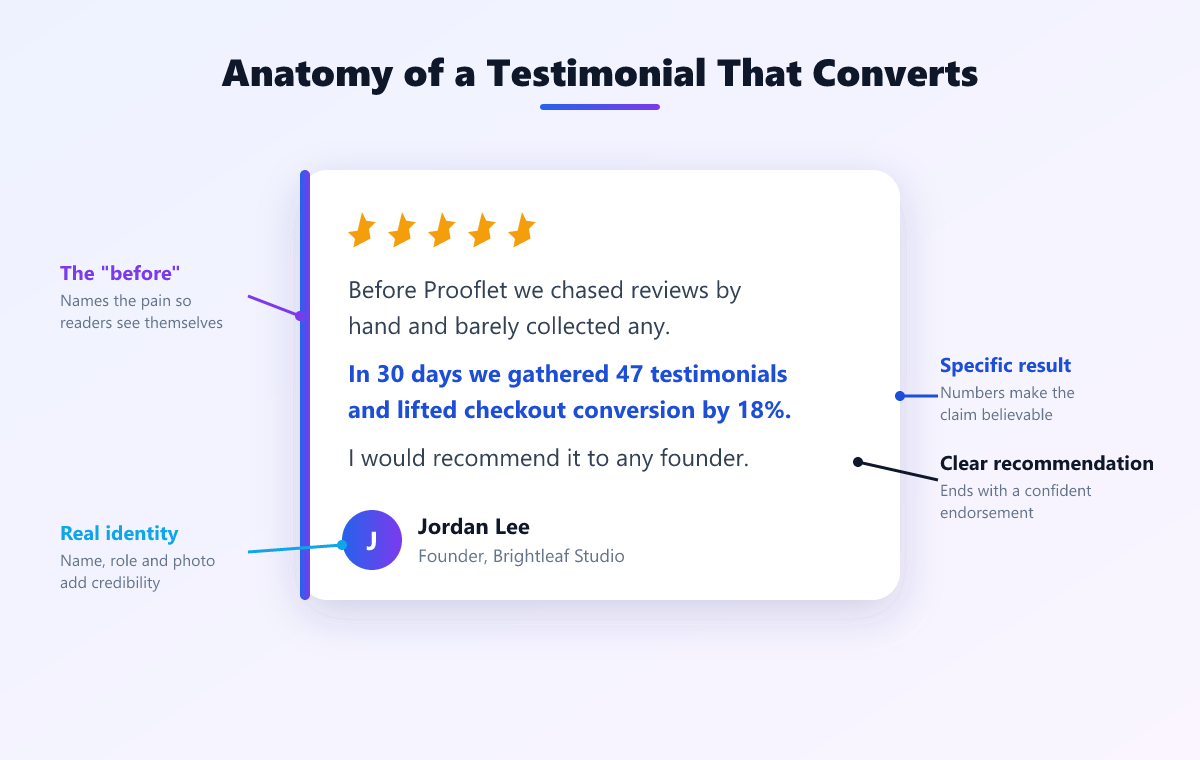
The three rules decide whether a testimonial works. The five-part format decides how it is put together. Short testimonials use the middle three parts (problem, action, result), which is the three-beat structure; longer ones use all five.
- Who: name, role, company, and photo. This is rule 2.
- The problem: what was going on before, in one sentence.
- The action: what they chose and why, or what changed.
- The result: one specific outcome, with a number. This is rules 1 and 3.
- The recommendation: who else should use it.
[Problem] Our onboarding took three weeks and new hires felt lost. [Action] We moved every step into one checklist. [Result] It now takes four days, and new hires ship work in week one. [Recommendation] Any team hiring fast should try it.
[Who] Jon Park, COO, Relay Freight
An illustrative example of all five parts.
How long a testimonial should be
| Format | Ideal length | Where it works |
|---|---|---|
| Headline quote | Under 25 words | Hero sections, ads, beside a button |
| Written testimonial | 40 to 80 words (2 to 4 sentences) | Landing pages, pricing pages, testimonial walls |
| Video testimonial | 30 to 90 seconds | Landing pages, sales emails, wall of love |
| Audio testimonial | 20 to 60 seconds | Podcasts, product pages with a transcript |
| Case study | 500 to 1,500 words | B2B sales, dedicated story pages |
Under 25 words there is only room for one result, which suits a headline but reads as thin on its own. Past 80 words, readers skim and miss the number that matters.
Text vs video vs audio testimonials
| Text | Video | Audio | |
|---|---|---|---|
| Persuasion | Good | Highest | High |
| Effort for the customer | Lowest | Highest | Low |
| Scannable | Yes | No, needs a caption | No, needs a transcript |
| Indexed by search | Yes | Only with a transcript | Only with a transcript |
| Best use | Beside claims, pricing, checkout | Landing pages, wall of love | Customers who will not go on camera |
Offer all three in the same request. A customer who will not record a video will often record 40 seconds of audio, and every video needs a text caption to be scanned and indexed.
What to include in each format
- Text: the quote, full name, role, company, photo, and the date it was given.
- Video: the person introducing themselves on screen, captions, a one-line pull quote as the title, and the duration.
- Audio: a transcript, the person's name and photo, and a waveform or play button.
- Every format: written consent to publish, and the customer's approval of any edits.
How good testimonials go wrong
- Over-editing. Polishing every quote into the same voice breaks rule 2: ten customers start to sound like one copywriter.
- Adjectives instead of numbers. “Incredible”, “amazing”, and “game-changing” break rule 1. Replace each one with the fact behind it.
- Listing features. A testimonial that lists what the product does breaks rule 3. Say what one feature changed.
- Inventing or strengthening claims. Never add a number the customer did not give. In the US, fake or altered testimonials are illegal under the FTC's rules.
Collect testimonials that follow the rules
The fastest way to get testimonials that pass all three rules is to ask questions that produce them: what was the problem, what changed, and what is one specific result. Prooflet collection forms build those prompts in, let customers answer in text, audio, or video, and can include a marketing consent statement. For finished examples, see our 20 testimonial examples, and for layouts, the testimonial design guide.
Frequently Asked Questions
1. What three things should testimonials always be?
Testimonials should always be specific, attributed to a named person, and focused on a result rather than a feeling. A specific testimonial names a real problem and a real number, attribution gives readers a name, role, company, and photo to trust, and a result shows what changed.
2. What is the best format for a testimonial?
The best format has five parts: who the person is, the problem they had, what they did, the result with a number, and a recommendation. Keep written testimonials to 40 to 80 words and video testimonials to 30 to 90 seconds.
3. What makes a good testimonial?
Three rules make a good testimonial: it is specific, it is attributed to a named person with a photo, and it describes a result instead of a feeling. “Great service” breaks all three. “Cut our onboarding from three weeks to four days” follows them.
4. Is video or text better for testimonials?
Video persuades more because the viewer sees a real face and hears a real voice, which makes it hard to fake. Text is faster to collect, easier to scan, and indexable by search engines. Use text beside claims and at checkout, and video on landing pages and your wall of love.