12 Employee Testimonial Examples (And the 5-Part Structure)
Updated

On this page
- The 5-part structure
- 12 employee testimonial examples
- 1. Software engineer
- 2. Sales
- 3. Customer support
- 4. Nursing
- 5. Warehouse and operations
- 6. Marketing
- 7. Intern to full-time
- 8. Remote work
- 9. Returning parent
- 10. Career changer
- 11. Finance
- 12. Hospitality
- Where to use employee testimonials
- How to collect employee testimonials
- Writing a testimonial for an employee
- Customer testimonials are a different job
- Frequently Asked Questions
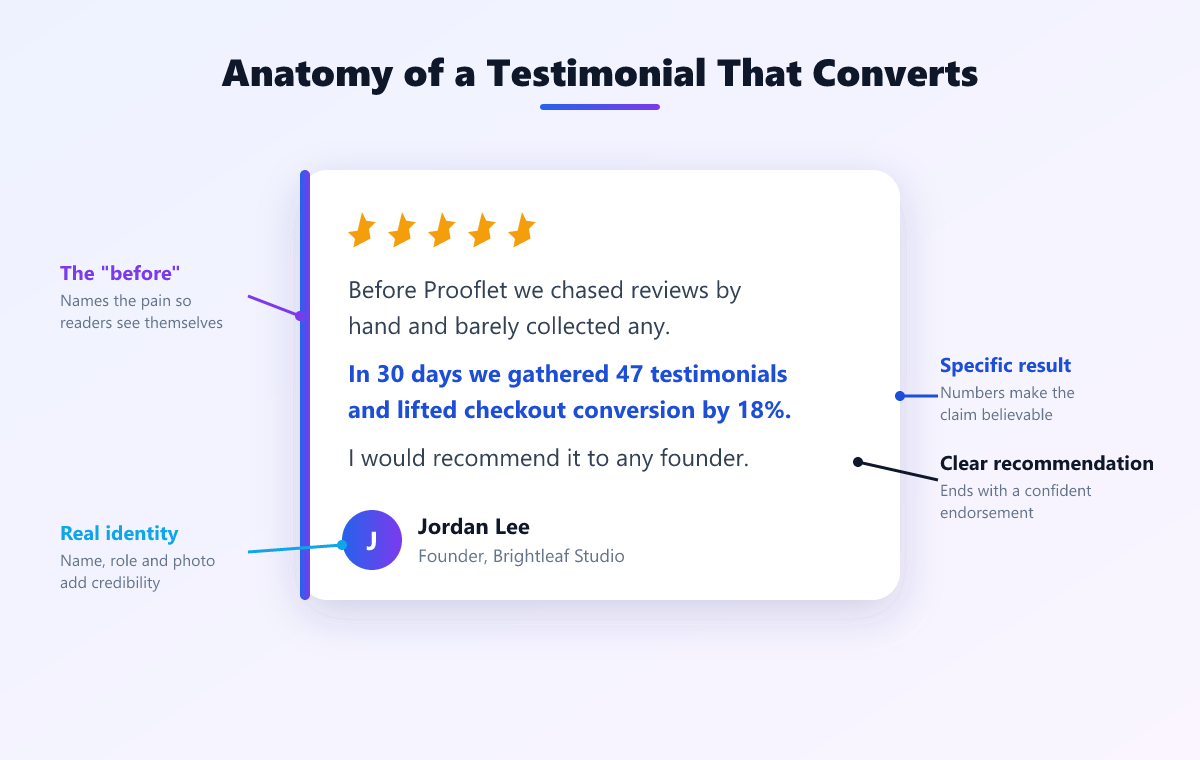
An employee testimonial needs five parts: the person's role, how long they've been there, one specific project or moment, what changed for them, and who they'd recommend the company to. Here are 12 examples that follow it.
This guide is for HR, recruiting, and employer branding teams collecting testimonials from their own staff. If you are a manager writing a testimonial about an employee, skip to writing a testimonial for an employee.
The 5-part structure
- Role: what they do. Candidates look for their own job title first.
- Tenure: how long they have been there. Tenure is proof people stay.
- One specific project or moment: a promotion, a launch, a time the company showed up for them.
- What changed for them: a skill, a role, a salary, a schedule.
- Who they would recommend it to: this tells the right candidates they belong.
12 employee testimonial examples
One per role or situation. Names are left out so you can swap in your own people; the examples are illustrative.
1. Software engineer
I joined to work on payments and ended up leading our move to a new billing system in my second year. Nobody here waits for permission to fix something that is broken. If you want your work to ship and matter, this is the place.
Backend Engineer, 3 years at the company
Why it works: It proves ownership with one project, which says more than “we value autonomy” in a careers page headline.
2. Sales
My first quarter I closed nothing, and my manager spent an hour a week on my calls instead of on my numbers. By quarter four I was at 130% of quota. I would recommend this team to anyone who wants to be coached, not just managed.
Account Executive, 2 years at the company
Why it works: It admits a rough start, which makes the result credible and shows how the company treats people who struggle.
3. Customer support
I was promoted to team lead after a year, and the company paid for my training. We get real time to fix root causes, not just close tickets. Anyone who likes solving problems properly would do well here.
Support Specialist, 18 months at the company
Why it works: Promotion and paid training are the two proofs a support candidate looks for first.
4. Nursing
Our ward runs a real one-to-five nurse ratio, even on nights. When my mother was ill, my manager rearranged the rota within a day. I have stayed four years because the support is real, and I recommend it to any nurse who is burned out elsewhere.
Registered Nurse, 4 years at the company
Why it works: It names a staffing number and a personal moment, the two things nurses compare between employers.
5. Warehouse and operations
I started on the packing line and now supervise a team of 22. Safety comes before speed here, and they mean it. If you want a place where you can move up without a degree, this is it.
Shift Supervisor, 5 years at the company
Why it works: A visible path from entry level to supervisor is the strongest claim an operations employer can make.
6. Marketing
In my first six months I launched the company blog, and it now brings in a third of our signups. My ideas get tested, not debated for weeks. Anyone who likes seeing their work move a number would love this team.
Content Marketing Manager, 2 years at the company
Why it works: It ties the employee's work to a company result, which attracts candidates who want impact.
7. Intern to full-time
I came in as a summer intern and was offered a full-time role before the internship ended. My intern project is still used by the finance team every week. I would recommend the internship to any student who wants real work, not coffee runs.
Data Analyst, 1 year at the company
Why it works: Intern testimonials sell to students by proving the work is real and the path to a job exists.
8. Remote work
I have worked fully remote from three countries without ever feeling out of the loop. Meetings are rare and written updates are the default. If you do your best work in quiet focus, you will fit in here.
Product Designer, 3 years at the company
Why it works: It gives remote candidates the specifics they worry about: inclusion, meetings, and how work gets communicated.
9. Returning parent
I came back after four years at home with my kids, and they hired me for what I could do, not the gap on my CV. I work school hours and I have never had to apologise for it. I recommend it to every parent returning to work.
Project Manager, 2 years at the company
Why it works: It speaks directly to a group many employers overlook, with a concrete detail about flexibility.
10. Career changer
I was a teacher until last year. The apprenticeship paired me with a senior engineer for six months, and I shipped my first feature in week five. Anyone thinking of switching careers should know this team takes beginners seriously.
Junior Developer, 1 year at the company
Why it works: Career changers need proof that the company invests in training. A week-five first feature is that proof.
11. Finance
I sat in on board meetings in my first year, which never happened at the bank I left. The work is varied, the hours are sane, and my manager talks about my development every month. I recommend it to any analyst who wants more than spreadsheets.
Financial Analyst, 3 years at the company
Why it works: It contrasts with a previous employer, which answers the question every lateral hire is asking.
12. Hospitality
I started as a server on weekends at university. Six years later I run the restaurant, and the owners still ask for my opinion on every new menu. If you want to grow in hospitality instead of just working shifts, start here.
Restaurant Manager, 6 years at the company
Why it works: Six years from server to manager proves internal promotion better than any policy statement.
Where to use employee testimonials
| Placement | Best format | Tip |
|---|---|---|
| Careers page | Grid of photos and quotes, plus 1 or 2 videos | Cover every major department |
| Job postings | One quote from someone in the same role | Match the role exactly |
| Short video, 30 to 60 seconds | Post from the employee's own account with their agreement | |
| Recruitment emails | One sentence with a link to the full story | Use a testimonial from the candidate's future team |
How to collect employee testimonials
- Make it voluntary. A testimonial someone felt pressured to give reads that way. Ask, and accept no.
- Ask the five questions, one per part of the structure, instead of “would you write something about working here?”
- Offer video, audio, or text. Many people will talk for 60 seconds who would never write a paragraph.
- Get written consent to use their name, photo, and words, and let them approve edits.
- Refresh yearly. Remove testimonials from people who have left.
Writing a testimonial for an employee
If a current or former employee has asked you for a testimonial, you are writing a reference, not an employer branding quote. Cover four things in 75 to 200 words: how long you worked together and in what capacity, one or two achievements with numbers, two or three qualities you saw in action, and a clear recommendation. Sign it with your name, title, and contact details.
See our testimonial letter samples for a full employee letter, and how to write a testimonial for short versions about colleagues and employees.
Customer testimonials are a different job
Employee testimonials help you hire. Customer testimonials help you sell, and they follow different rules. For those, see our 20 customer testimonial examples. Prooflet collects both through branded forms with guided prompts, so employees can record a video or write a quote in the browser.
Frequently Asked Questions
1. What is an example of a good employee testimonial?
“I started on the packing line and now supervise a team of 22. Safety comes before speed here, and they mean it. If you want a place where you can move up without a degree, this is it.” It works because it names a role, a specific change, and who should apply.
2. How to write a good testimonial for an employee?
If you are a manager writing about an employee, state how long you worked together, one specific achievement with a number, two or three qualities you saw in action, and a clear recommendation. Keep it to 75 to 200 words and sign it with your name, title, and contact details.
3. What should an employee testimonial include?
Five parts: the person's role, how long they have been at the company, one specific project or moment, what changed for them, and who they would recommend the company to. Add their full name and photo with their consent.
4. Where should employee testimonials be used?
On your careers page, in job postings, on LinkedIn, in recruitment emails, and in onboarding material. Match the testimonial to the role: a sales testimonial belongs on a sales job posting.