20 Testimonial Examples That Convert (And Why They Work)
Updated

On this page
- What separates a good testimonial from a useless one
- 20 testimonial examples that convert
- 1. The before and after result (SaaS)
- 2. The video testimonial with metrics (agency)
- 3. The social media screenshot (ecommerce)
- 4. The short text testimonial (freelancer)
- 5. The case study testimonial with ROI (B2B)
- 6. The employee testimonial (hiring)
- 7. The customer success story (subscription)
- 8. The expert endorsement
- 9. The peer testimonial (community)
- 10. The comparison testimonial (we switched from X)
- 11. The problem and solution testimonial
- 12. The emotional testimonial
- 13. The influencer testimonial
- 14. The user generated content testimonial
- 15. The audio testimonial
- 16. The transformation story (coaching)
- 17. The local service review (trades)
- 18. The price objection testimonial (pricing page)
- 19. The long-term customer (retention)
- 20. The feature proof testimonial (product page)
- Short testimonial examples
- Testimonial examples for business
- 1. Support ticket volume
- 2. Agency retainer
- 3. Implementation partner
- 4. Sales enablement
- 5. Supplier
- 6. Consultant
- 7. Managed IT
- 8. Legal services
- Sample testimonial for good service
- 1. Restaurant
- 2. Home services
- 3. Customer support
- 4. Hotel
- 5. Car service
- 6. Salon
- Customer testimonial examples by industry
- 1. SaaS customer testimonial
- 2. Ecommerce customer testimonial
- 3. Agency customer testimonial
- 4. Coaching customer testimonial
- 5. Local service customer testimonial
- 6. Healthcare customer testimonial
- 7. Education customer testimonial
- 8. Finance customer testimonial
- How to get testimonials like these
- Where to put them
- Mistakes that make real testimonials look fake
- Turn the examples into your own
- Frequently Asked Questions
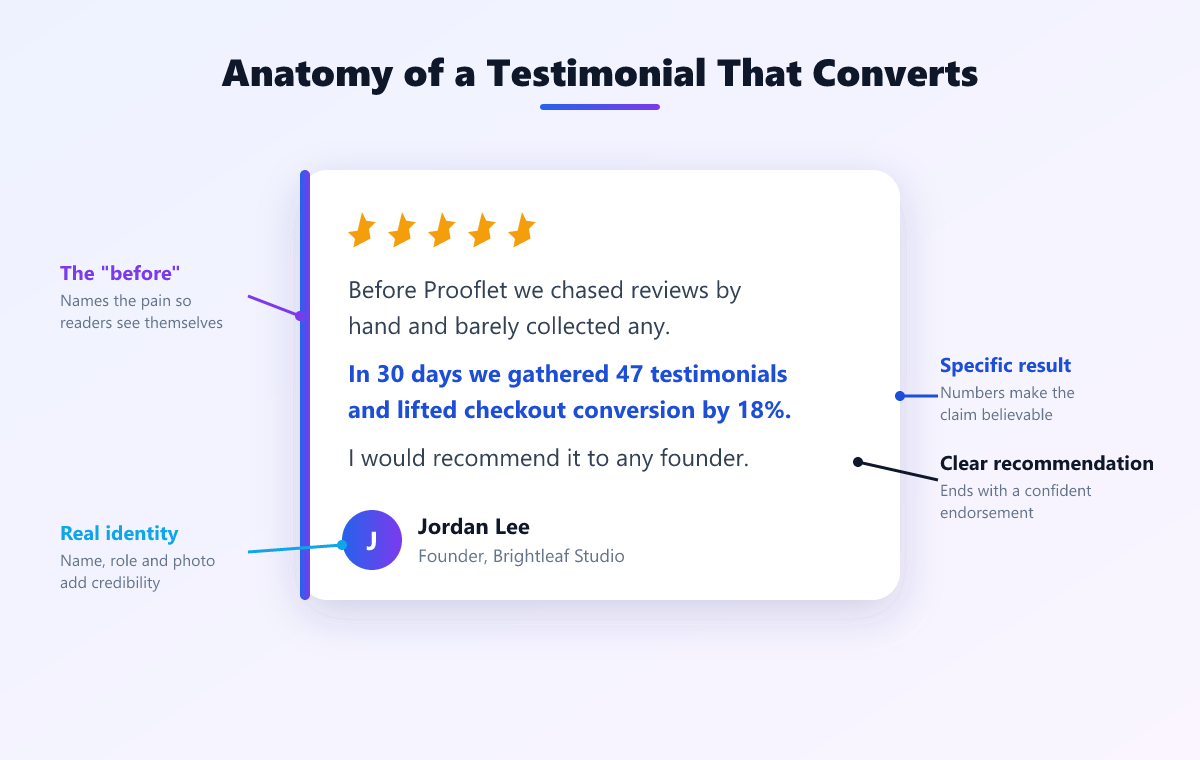
The best customer testimonials share three traits: a specific problem, a measurable result, and a named person with a photo. Below are 20 examples across SaaS, ecommerce, agencies and coaching, each annotated with why it works.
Quick answer: The best testimonials share three things: a specific problem, a concrete result, and an emotional reaction. A vague "Great product!" converts nobody. A specific "We reduced churn by 34% in 60 days" converts everyone. The five most effective types are before-and-after results with specific metrics, video testimonials showing real emotion, social media screenshots with context, case study testimonials with ROI data, and comparison testimonials explaining why a customer switched from a competitor.
The 20 examples cover SaaS, ecommerce, agencies, freelancing, B2B, coaching, local services, and hiring. Each one includes why it works and a fill-in template you can adapt. The names and companies are illustrative, written to show the structure; the patterns are drawn from the testimonials that actually perform.
What separates a good testimonial from a useless one
Before the examples, the diagnostic. A testimonial is doing work if it passes three tests:
- The specificity test. Could a competitor's customer have written this exact sentence? If yes, it is filler.
- The falsifiability test. Does it contain a claim that could be checked, such as a number, a timeframe, or a named alternative? Checkable claims are believed; unfalsifiable praise is not.
- The objection test. Does it answer something a hesitant buyer is actually worried about, like migration effort, setup time, or hidden cost?
A testimonial that passes all three will outperform ten that pass none. That is why five strong testimonials beat fifty weak ones, and why collecting with guided questions matters more than collecting in volume.
20 testimonial examples that convert
1. The before and after result (SaaS)
Before Prooflet we were chasing testimonials over email and getting maybe one in ten back. Six weeks in we have 34 published, and the pricing page converts 22% better than it did in Q1.
Priya Raman, Head of Growth at a B2B analytics startup
Why it works: It contrasts a clearly bad starting state with a specific end state, and both numbers are the kind a real operator would know. The reader can picture their own before state in the first sentence.
Template: Before [product] we were [painful old process] and getting [poor result]. [Time period] in we have [new result], and [metric] improved by [number].
2. The video testimonial with metrics (agency)
I run a six person agency. We used to lose pitches to bigger shops on credibility alone. We started opening every proposal with a 40 second client video, and our close rate went from about a third to just over half.
Marcus Bell, founder of a design agency, recorded on video
Why it works: Video carries tone and face, which is why it converts roughly twice as well as text, and the specific close rate change keeps it from being a vague endorsement. The speaker also names their company size, so similar buyers self identify.
Template: I run a [size and type of business]. We used to [specific competitive problem]. We started [change], and [metric] went from [before] to [after].
3. The social media screenshot (ecommerce)
ordered thursday, arrived saturday, and the packaging is so nice i kept the box. third order this month, send help
A customer post on X, screenshotted with the handle and timestamp visible
Why it works: Unpolished, lowercase, and clearly not written for you, which is exactly why it reads as authentic. Screenshots carry the platform's own credibility, and the visible timestamp makes the claim checkable.
Template: Screenshot the original post with handle, avatar, and timestamp intact. Never retype a social post as a formatted quote; the native styling is doing the persuading.
4. The short text testimonial (freelancer)
Turned my messy brief into a finished brand in nine days. I have hired four designers before and none of them asked the questions Dana asked.
Tom Whitfield, founder, DTC coffee brand
Why it works: Two sentences, one timeframe, and one comparison against alternatives the buyer is probably also considering. Short testimonials work when every clause carries information, and a text testimonial form with guided questions is the easiest way to get them.
Template: [Outcome] in [timeframe]. I have [tried alternatives] before and none of them [specific differentiator].
5. The case study testimonial with ROI (B2B)
We spent $4,800 in year one. The workflow it replaced was costing us roughly 20 hours a month of coordinator time, so it paid for itself by month five and has been pure margin since.
Elena Fischer, Operations Director, 200 person logistics firm
Why it works: It shows the arithmetic instead of claiming good ROI. A buyer building a business case internally can lift this straight into their own justification, which is the highest value thing a testimonial can do in B2B.
Template: We spent [cost]. It replaced [specific cost or time], so it paid for itself by [point in time] and [ongoing benefit] since.
6. The employee testimonial (hiring)
I joined as the second engineer and I was shipping to production in my first week. Three years later I have never once been asked to work a weekend to hit an arbitrary date.
Sam Oduya, Staff Engineer
Why it works: Careers pages are full of claims about culture. This one makes a falsifiable statement about weekends that a candidate could verify by asking anyone else on the team, which is what makes it credible.
Template: I joined as [role and stage]. [Concrete early experience]. [Time] later I have never [specific negative that is common in the industry].
7. The customer success story (subscription)
Month one I nearly cancelled because I could not get the import to work. Support got on a call, fixed it in 20 minutes, and I have renewed twice since.
Rachel Okafor, small business owner
Why it works: It admits a real problem before resolving it. Testimonials that acknowledge friction are more believable than uniformly glowing ones, and this one turns a support interaction into the proof point.
Template: [Time period] I nearly [churned or gave up] because [genuine problem]. [How it was resolved]. [Ongoing loyalty signal].
8. The expert endorsement
I have audited testimonial tooling for 30 or so DTC brands. Most of them are widget libraries with a form bolted on. This is one of the few that treats collection and display as the same problem.
Dr. Amara Singh, conversion research consultant
Why it works: Authority plus a specific basis for that authority, which is the number of brands audited. The mild criticism of the wider category makes the endorsement read as a judgment rather than a favour.
Template: I have [credential and volume of experience]. Most [category] are [honest critique]. This is one of the few that [specific differentiator].
9. The peer testimonial (community)
Asked in the Slack whether anyone had actually shipped with this. Four people replied within an hour, all positive, two of them unprompted about the support. That was enough for me.
Jordan Reyes, indie founder
Why it works: The persuasion is peer consensus rather than the vendor's claim. It works especially well for products bought by people who belong to an identifiable community.
Template: Asked [peer group] whether anyone had [used it for real]. [Response volume and speed]. That was enough for me.
10. The comparison testimonial (we switched from X)
We moved off a $59/month plan we had been on for two years. Same features for us, paid once, and migration took a 30 minute call. The only thing I regret is not doing the maths sooner.
Nadia Haddad, marketing lead, SaaS company
Why it works: It addresses the switching objection directly, including the migration effort, which is the thing that actually stops people from moving. Comparison testimonials are the highest intent of any type because the reader is already evaluating alternatives. If you are weighing up the tools yourself, see our Senja vs Testimonial.to vs Famewall comparison.
Template: We moved off [previous solution and cost]. [Honest feature comparison], and switching took [effort]. The only thing I regret is [not switching sooner].
11. The problem and solution testimonial
Our testimonials lived in a spreadsheet, three inboxes, and someone's DMs. Now they are in one place and the marketing team can pull a quote for a landing page without asking me.
Chris Delaney, COO
Why it works: The opening line is a mess the reader recognizes instantly. The resolution is described as a change in who can do what, which is more concrete than saying the tool is organized.
Template: Our [asset] lived in [scattered mess]. Now [single source of truth] and [team] can [do something] without [bottleneck].
12. The emotional testimonial
I had put off asking clients for testimonials for two years because it felt like begging. Having a form to send made it a normal request instead of a favour. That sounds small. It was not.
Beth Larkin, freelance copywriter
Why it works: It names a feeling the target reader almost certainly shares but would not say out loud. Emotional testimonials do not convert on their own, but placed beside a results testimonial they handle the objection the numbers cannot.
Template: I had put off [action] because it felt like [uncomfortable feeling]. [What changed] made it [reframe]. That sounds small. It was not.
13. The influencer testimonial
Genuinely did not expect to keep using this after the sponsorship ended. Six months later it is still what I use for every client wall.
A creator with 40k followers in the marketing niche, disclosed as a former paid partnership
Why it works: The disclosure is what makes it work. Acknowledging the commercial relationship and then stating the behaviour that continued after it ended converts a paid mention into evidence. Undisclosed influencer endorsements also breach FTC guidance in the US.
Template: Did not expect to keep using this after [commercial relationship] ended. [Time] later it is still [continued behaviour]. Always disclose the relationship.
14. The user generated content testimonial
A customer filmed their own unboxing, put our widget on their agency site, and tagged us. We asked permission and now it is the first thing on our homepage.
Content a customer created independently, republished with permission
Why it works: Nobody asked for it, which is the whole point. UGC costs nothing to produce and outperforms studio content on believability. Always get written permission before republishing.
Template: Find posts where customers already showed your product unprompted. Ask permission in writing, credit the creator, and link back to the original.
15. The audio testimonial
Forty seconds, recorded from a car park between meetings, and it is the most convincing thing on our site because you can hear that she means it.
Audio clip from a client, embedded with a transcript
Why it works: Audio captures the tone that makes video persuasive without the self consciousness that stops people agreeing to be filmed. Response rates are markedly higher than video, and a transcript keeps it accessible and indexable.
Template: Offer audio as a third option beside video and text. Embed the waveform with a visible transcript so the content is accessible and crawlable.
16. The transformation story (coaching)
I came in wanting to stop working weekends. Twelve weeks later I have hired my first assistant, raised my rates by 30%, and I have not opened my laptop on a Saturday since June.
Founder of a bookkeeping practice, coaching client
Why it works: Coaching sells an outcome the buyer cannot see in advance, so the before state does the persuading. The reader recognises the goal in the first sentence, and three concrete changes prove it happened.
Template: I came in wanting to [personal goal]. [Time period] later I have [change one], [change two], and [change three].
17. The local service review (trades)
Called at 8am about a leaking pipe, and they were here by 10. Fixed in an hour, cleaned up after themselves, and charged exactly what they quoted on the phone.
Homeowner, verified Google review
Why it works: It answers the three worries every local customer has: how fast, how tidy, and whether the price will change. Showing it as a verified Google review borrows the platform's credibility.
Template: Called at [time] about [problem], and they were here by [time]. [Result], [tidiness or manner], and [price matched the quote].
18. The price objection testimonial (pricing page)
I hesitated at the price for a month. It paid for itself in the first six weeks: we cancelled two other subscriptions and stopped paying a freelancer to assemble reports.
Operations manager at a 25-person agency
Why it works: It names the objection out loud before answering it, which is exactly the thought a buyer has on the pricing page. The payback is specific enough to check against their own costs.
Template: I hesitated at [the objection] for [time]. It paid for itself in [time period]: we [saving one] and [saving two].
19. The long-term customer (retention)
We signed up in 2021 expecting to switch within a year. Five years on, it runs our entire onboarding, and the team fights me whenever I suggest trying something else.
Head of People at a logistics company
Why it works: Tenure answers a question no feature list can: does it hold up after the first month? Five years of use is proof a new customer will not regret the decision.
Template: We signed up in [year] expecting [low expectation]. [Years] on, it [what it does for them now], and [sign of attachment].
20. The feature proof testimonial (product page)
The automatic captions alone save me an hour per video. I used to pay for a separate transcription tool; now every testimonial is captioned before I even open it.
Marketing lead at an online course business
Why it works: It proves one product claim in the customer's words, so it belongs directly beside that feature on the page. Feature testimonials placed next to the feature convert far better than a generic quote in a carousel.
Template: The [feature] alone saves me [time or money] per [unit]. I used to [old workaround]; now [what happens automatically].
Short testimonial examples
A short testimonial has to earn its place in under 25 words, so it needs one specific result and nothing else. These 12 fit under a headline, beside a button, or in an ad. All are illustrative.
- “Set up in ten minutes. Collected 14 video testimonials in the first week.” Founder, SaaS startup
- “Our checkout conversion rose 11% the month we added reviews beside the button.” Ecommerce store owner
- “Three weeks of onboarding became four days.” Operations lead, logistics company
- “She rewrote our homepage and demo requests doubled in 30 days.” Client of a freelance copywriter
- “Fixed a leak two other plumbers missed, and charged exactly what he quoted.” Homeowner
- “I passed the exam first time after failing it twice on my own.” Student, online certification course
- “Replied within an hour, every single time, for six months.” Client of a web design agency
- “Lost 9 kg in 12 weeks without giving up a single meal I love.” Coaching client
- “We cut software spend by $1,200 a month by replacing three tools with this one.” Finance manager, 40-person company
- “The only accountant who has ever explained my taxes in plain English.” Small business owner
- “Booked solid for the season after the new site went live.” Owner, holiday rental
- “Hired two of our best engineers through their shortlist in under a month.” Head of Talent, fintech
Each one names a number, a timeframe, or a before and after. Cut any short testimonial that could describe a competitor as well as you. For 15 more, grouped by where they go on your site, see our short testimonial examples.
Testimonial examples for business
B2B buyers are spending someone else's money, so a business testimonial has to prove a measurable outcome and name the role of the person vouching for it. These 8 examples cover the most common B2B situations. All are illustrative.
1. Support ticket volume
We cut first-response time from nine hours to 40 minutes without adding headcount. The routing rules alone paid for the annual contract in the first quarter.
VP of Customer Support, B2B software company
2. Agency retainer
They took over our paid search at a cost per lead of $180 and brought it to $72 in five months. Every weekly report told us what changed and why.
Marketing Director, commercial insurance broker
3. Implementation partner
The migration moved 11 years of records with zero downtime over one weekend. Our team started Monday on the new system as if nothing had happened.
IT Manager, regional accounting firm
4. Sales enablement
Win rate on enterprise deals went from 19% to 31% after we rolled out their training. New reps now close their first deal in week six instead of month four.
CRO, HR software company
5. Supplier
In three years they have never missed a delivery window. When a shipment was delayed at port, they told us before we noticed and rerouted at their cost.
Head of Procurement, food manufacturer
6. Consultant
Their pricing review found $340,000 in annual revenue we were leaving on the table. The recommendations took two weeks to implement.
CEO, subscription analytics company
7. Managed IT
We went from weekly outages to one incident in twelve months. Our staff stopped keeping paper backups of everything, which says it all.
Practice Manager, dental group
8. Legal services
They turned around our vendor contracts in 48 hours instead of the three weeks our last firm needed, and the fees were fixed up front.
COO, 60-person logistics company
What they share: a job title the buyer respects, a before and after number, and a timeframe. Put them beside the claim they prove; our guide to displaying testimonials on your website covers where.
Sample testimonial for good service
A good-service testimonial proves reliability, which is harder to show than a result. The strongest ones describe one moment where the business did something it did not have to. Here are 6 samples. All are illustrative.
1. Restaurant
Our server noticed my daughter's allergy note before we did and walked us through every dish. We have been back four times since.
Restaurant customer
2. Home services
They arrived at 8:00 as promised, protected every floor, and finished a day early. The quote and the invoice matched to the dollar.
Home services customer
3. Customer support
My order was lost in transit. One email, one reply within 20 minutes, and a replacement arrived two days later with no questions asked.
Customer support customer
4. Hotel
The front desk remembered our names by the second morning and moved us to a quieter room without being asked twice.
Hotel customer
5. Car service
They found the real fault after two other garages guessed wrong, and called before doing any work that was not on the original quote.
Car service customer
6. Salon
Twelve years of visits and not one appointment has started late. That consistency is why I drive 30 minutes past three other salons.
Salon customer
Notice the pattern: a specific time, a specific promise kept, and a reason the customer came back. “Great service” proves nothing; “arrived at 8:00 as promised and finished a day early” proves everything.
Customer testimonial examples by industry
A customer testimonial persuades when it answers the specific worry buyers have in that industry. Here are 8 examples, one per industry, each with the reason it works. All are illustrative.
1. SaaS customer testimonial
We replaced three separate tools with one and cut our software bill by $14,000 a year. The migration took a single afternoon, and support answered every question within the hour.
Operations Director, 80-person logistics company
Why it works: Lead with the switch and the saving. SaaS buyers are almost always replacing something.
2. Ecommerce customer testimonial
Third order this year. The sizing guide was spot on, delivery took two days, and when one item arrived damaged they shipped a replacement before I even returned the first.
Verified buyer, repeat customer
Why it works: Repeat purchase is the strongest signal in ecommerce. Mention it, and mark the buyer as verified.
3. Agency customer testimonial
They rebuilt our paid social in six weeks and our cost per lead fell from $95 to $41. The weekly report tells us exactly what changed and why, in plain English.
Marketing Manager, home services franchise
Why it works: Agency clients want the number and the communication. Both appear here in two sentences.
4. Coaching customer testimonial
I came in wanting to stop working weekends. Twelve weeks later I have hired my first assistant, raised my rates by 30%, and I have not opened my laptop on a Saturday since June.
Founder, bookkeeping practice, coaching client
Why it works: Coaching outcomes are personal, so the before state carries the weight. Name the goal, then the change.
5. Local service customer testimonial
Called at 8am about a leaking pipe, and they were here by 10. Fixed in an hour, cleaned up after themselves, and charged exactly what they quoted on the phone.
Homeowner, verified Google review
Why it works: Speed, tidiness, and price matching the quote are the three things local customers worry about.
6. Healthcare customer testimonial
I put off the treatment for a year because I was nervous. The team explained every step before it happened, and I was back at work in three days instead of the week I had planned for.
Patient, published with written consent
Why it works: Focus on the experience rather than guaranteed clinical outcomes, and get written consent before publishing.
7. Education customer testimonial
I failed the certification exam twice studying alone. After the eight-week course I passed with 86%, and the practice tests were harder than the real exam, which is exactly what I needed.
Student, IT certification course
Why it works: Students trust a before and after with a score. The detail about the practice tests makes it credible.
8. Finance customer testimonial
Our accountant found $22,000 in deductions our previous firm had missed for two years running. Month-end close now takes three days instead of ten.
CFO, 45-person manufacturing business
Why it works: Finance buyers want precision. Exact figures read as more trustworthy than round ones.
Regulated industries: healthcare and financial advice have their own rules on testimonials. In the US, the FTC's Endorsement Guides apply to every industry, and investment advisers must follow the SEC Marketing Rule's disclosure requirements. Check the rules for your field before publishing.
How to get testimonials like these
None of the examples above came from asking "would you mind writing us a testimonial?" That question produces the vague praise you are trying to avoid, because it gives the customer no idea what you actually want.
Ask narrow questions instead, and the specificity takes care of itself:
- What problem were you trying to solve before you found us?
- What did you try first, and why did it not work?
- What specific result have you seen, and over what timeframe?
- What would you say to someone on the fence?
Ask within 48 hours of a win, while the customer still remembers the detail. Offer video, text, and audio in the same form, because the customer who will not go on camera will often record 40 seconds of audio. The full process is in how to get customer testimonials, and there are ready-made scripts in our testimonial request email templates.
Where to put them
Placement decides whether a good testimonial does anything. Three rules:
Put testimonials next to the claim they prove. A testimonial about fast setup belongs beside your setup copy, not in a carousel at the bottom of the page. Proof works when it is adjacent to the assertion it supports.
Put them at points of hesitation. Pricing tables, signup forms, and checkout are where buyers stall. A comparison testimonial beside a pricing table answers the objection at the moment it forms.
Give the rest their own page. A dedicated Wall of Love lets a serious buyer browse depth without cluttering the pages built to convert. Prooflet's testimonial widget renders walls, carousels, grids, and badges from one line of code, and the whole set updates when you publish a new testimonial.
Mistakes that make real testimonials look fake
- No attribution. An anonymous quote reads as invented. Name, photo, role, and company, or do not publish it.
- Over-editing. Polishing every quote into the same voice makes ten customers sound like one copywriter. Leave the imperfections in.
- All positive, no texture. A page where nobody had a single difficulty is less believable than one where a customer mentions a rocky start that got resolved.
- Stale proof. A testimonial dated four years ago suggests nobody has been happy since. Date them and keep them current.
- Inventing them. Beyond the obvious ethical problem, fabricated testimonials and fake review schema are enforceable under FTC rules in the US and can trigger a Google manual action.
Turn the examples into your own
Pick the three types closest to your business, take the templates, and send the questions to five recent customers who had a good outcome. You will get better material in a week than you would from a year of hoping testimonials arrive on their own.
Prooflet collects video, text, and audio through one branded form with guided prompts, imports the proof you already have on Google, LinkedIn, G2, and 30 or so other platforms, and publishes it all through a widget that loads in under 50ms. Plans are one-time, from $59, and there is a free forever plan. See the plans or read the testimonial software comparison first.
Frequently Asked Questions
1. What are some examples of testimonials?
Examples of testimonials include a before and after result (“we went from one testimonial a quarter to 34 in six weeks”), a short video with a metric, a screenshotted social post, a case study with ROI, and a comparison testimonial explaining why a customer switched. This page has 20 annotated examples.
2. What is an example of a good testimonial?
“Before this tool we were chasing testimonials over email and getting one in ten back. Six weeks in we have 34 published, and the pricing page converts 22% better.” It is good because it names a specific problem, a measurable result, and a timeframe.
3. What are examples of testimonials?
Testimonials come as written quotes, video clips, audio recordings, social media posts, case studies, and peer or expert endorsements. The strongest examples in every format share three traits: a specific problem, a measurable result, and a named person with a photo.
4. What is a testimonial example?
A testimonial example is a customer statement about their experience, such as: “Onboarding dropped from three weeks to four days.” A complete testimonial adds the person's name, role, company, and photo so readers can trust it.
5. What makes a good testimonial?
Specificity. A good testimonial names the problem the customer had, what they did about it, and a measurable result. “Great product!” persuades nobody because it could describe anything. “We cut onboarding from three weeks to four days” persuades because only a real customer could say it.
6. How long should a testimonial be?
Two to four sentences for text, and 30 to 90 seconds for video. Long enough to carry a problem, a solution, and a result; short enough that a visitor reads or watches to the end.
7. Should testimonials include photos?
Yes. A real name, a real face, a job title, and a company make a testimonial verifiable, and verifiable claims persuade far more than anonymous ones. An unattributed quote reads as something you could have written yourself.
8. How many testimonials do I need?
Start with five to ten strong ones. Display three to five on your homepage where they support a specific claim, and put the rest on a dedicated Wall of Love page that buyers can browse when they want more proof.
9. Can I edit a customer's testimonial?
Light edits for typos, filler, and length are fine and expected. Never change the meaning, invent a number, or strengthen a claim the customer did not make. Send the final version back for approval before it goes live.
10. What is the difference between a testimonial and a review?
You solicit a testimonial and publish it on your own site, so you control the placement and format. A review is left on a third party platform like Google or G2, where you control neither. Testimonials persuade on your landing pages; reviews build trust in search results. You want both.