
How to Write a Testimonial (Template + 10 Examples for Any Situation)
Updated
On this page
- The three-beat structure
- Testimonial template
- 10 testimonial examples for any situation
- Testimonial for a product
- Testimonial for a service
- Testimonial for a colleague
- Testimonial for an employee
- Testimonial for a student
- Testimonial for a friend
- Testimonial for a company
- Testimonial for a job application
- Testimonial for a freelancer
- Testimonial for a teacher
- How long should a testimonial be?
- What to avoid
- Asked for a testimonial and don't know where to start?
- For businesses: send this page to your customers
- Frequently Asked Questions
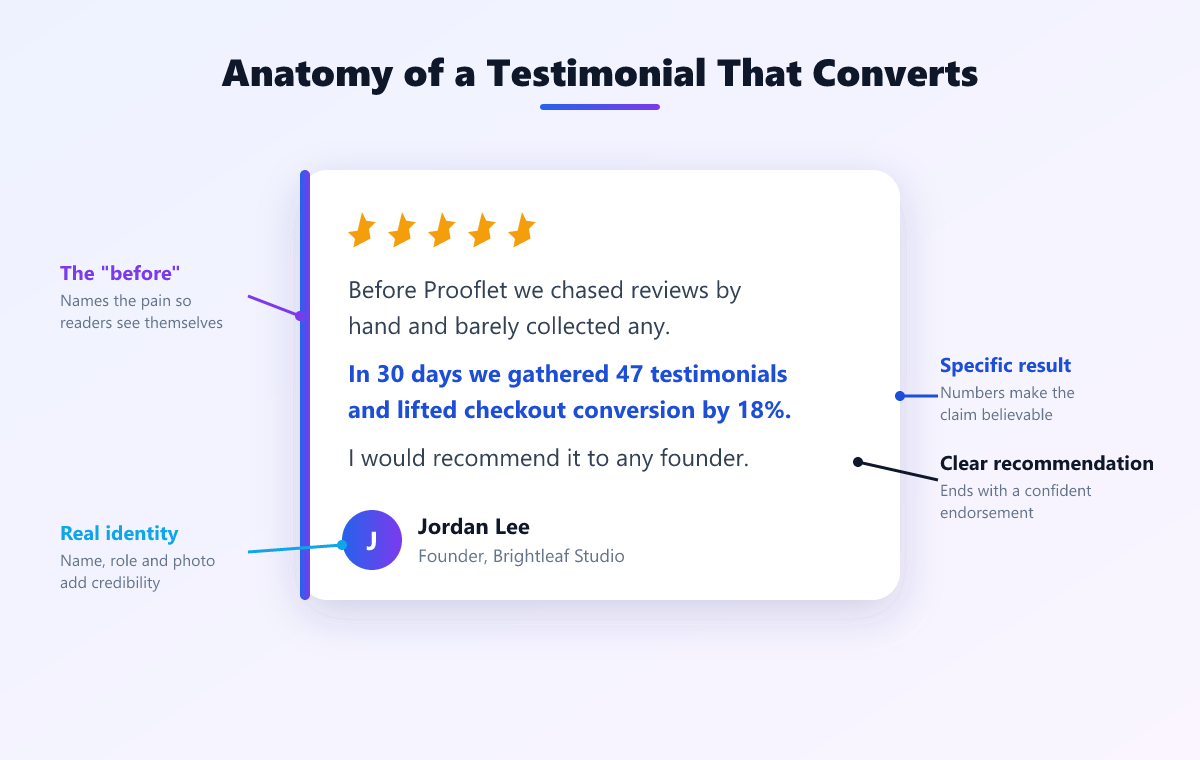
A testimonial that works follows three beats: the problem you had before, what changed, and one specific result. Two to four sentences is the right length. Long testimonials get skimmed and short ones read as thin. Use a real number wherever you have one. “Great service” persuades nobody; “cut our onboarding time from three weeks to four days” persuades everyone.
In short: a good testimonial has three parts: the problem before, what changed, and one specific measurable result. Keep it to 2 to 4 sentences, 40 to 80 words. Include a real number: “cut onboarding from three weeks to four days” outperforms “great service” by a wide margin.
This guide is for the person who has been asked to write one: a customer, a colleague, a manager, or a friend. It gives you the structure, a copy-paste template, and 10 filled examples for different situations.
The three-beat structure
- The problem. What was going on before? One sentence. This is what lets a reader recognise their own situation.
- The change. What did the product, service, or person do? One or two sentences, about what happened rather than a list of features.
- The result. What is different now? Make it specific: a number, a time saved, a before and after. End with who you would recommend it to.
Here is the structure in a 43-word testimonial:
[Problem] Our onboarding took three weeks and new hires felt lost. [Change] We moved every step into one checklist in this tool. [Result] Now it takes four days, and new hires ship work in their first week. I would recommend it to any team hiring fast.
Testimonial template
Copy this, fill in the brackets, and delete the labels:
[The problem] Before [product / service / person], I was
[the situation, frustration, or goal, in one sentence].

[What changed] [What they did or what you started doing].

[The result] Now [one specific result: a number, a time saved,
a before and after]. I would recommend [them / it] to anyone who
[describes the reader who has your old problem].

[Your name], [your role], [your company or context]
If a sentence does not fit your situation, cut it. A three-sentence testimonial with a real number beats a five-sentence one without.
10 testimonial examples for any situation
Each example below follows the three beats and stays between 40 and 80 words. The names are illustrative. Swap in your own details, and keep the specifics.
Testimonial for a product
Name the task the product made easier and put a number on it.
“We were spending every Friday afternoon building client reports by hand in spreadsheets. With this tool the reports build themselves overnight, and my team got back about four hours a week. It took one afternoon to set up, and we have not opened the old spreadsheet since March.”
48 words
Testimonial for a service
Describe one moment where the service went beyond what you paid for.
“Our boiler failed on the coldest night of January. They answered at 10pm, arrived within an hour, and had the heating back on before midnight. The price matched the quote exactly, and the engineer called the next morning to check it was still running. They are the only number we keep on the fridge.”
54 words
Testimonial for a colleague
Write in your own voice about one project you shared, and the result.
“I worked with Priya for three years on the payments team. When our checkout failure rate hit 4%, she traced it to a timeout nobody else had spotted and cut failures to under 0.5% in two weeks. She explains complex problems so clearly that the whole team learns from her. I would work with her again tomorrow.”
57 words
Testimonial for an employee
As a manager, give the role, one achievement, and why you would rehire them.
“Marcus joined us as a junior account manager and within 18 months was running our five largest accounts. He grew renewals on his book from 81% to 94% by visiting every client in person before each renewal. He is reliable, calm under pressure, and the person new hires ask for help. Any team would be lucky to have him.”
59 words
Testimonial for a student
As a teacher or tutor, describe the student's progress with a before and after.
“I taught Ana in advanced chemistry for two years. She started the course with a C and finished with the highest mark in a class of 28, mostly because she stayed after lessons to work through every problem she got wrong. She is curious, persistent, and generous with classmates who were struggling. I recommend her without reservation.”
57 words
Testimonial for a friend
Keep it specific and credible. Describe what you have seen them do, not only who they are.
“I have known Sam for ten years, and for the last four I have watched him build his photography business from weekend shoots into full-time work. He photographed my wedding and delivered 400 edited photos in nine days, two days early. He is organised, easy to be around, and makes nervous people relax in front of a camera.”
58 words
Testimonial for a company
Speak for your organisation: what you hired them for and what changed.
“We hired Northgate to rebuild our website after two failed attempts with other agencies. They launched on time, on budget, and our demo requests rose from 30 to 70 a month within one quarter. Their weekly updates meant we never had to chase them for anything. We have since hired them for two more projects.”
55 words
Testimonial for a job application
Written by a former manager or client to support an application. Tie it to the job's skills. For a full formal letter, see our testimonial letter samples.
“Leah managed our customer support team of 12 for three years. She cut average response time from nine hours to under one, rewrote our help centre, and trained every new hire herself. Customer satisfaction scores rose from 78% to 93% on her watch. She would be an outstanding hire for any role that combines people and process.”
57 words
Testimonial for a freelancer
Freelancers live on referrals, so name the brief, the delivery, and whether you would hire them again.
“We hired Jonah to write our onboarding emails after our free trial conversion stalled at 9%. He interviewed five of our customers before writing a word, and the new sequence lifted conversion to 14% in the first month. He met every deadline and took feedback without ego. We have booked him for two more projects.”
55 words
Testimonial for a teacher
As a student or parent, describe how the teacher changed the outcome.
“Mr. Hale took over my son's maths class in Year 9, when he had decided he was bad at maths. By the end of the year he was in the top set and asking for extra problems at home. Mr. Hale explained every idea two or three different ways until it clicked, and never once made a question feel stupid.”
60 words
How long should a testimonial be?
Two to four sentences, 40 to 80 words. That is long enough to hold a problem, a change, and a result, and short enough to be read in full on a website or in a proposal. Under 25 words, a testimonial only has room for one result, which works for a headline or an ad but reads as thin on its own. Over 100 words, readers skim it and miss the number that matters.
The exception is a formal reference or recommendation letter for a job or school application, which runs to three or four short paragraphs.
What to avoid
- Superlatives with no substance. “Amazing, incredible, best ever” tells the reader nothing they can check. Replace each adjective with the fact behind it.
- Listing features. “It has reporting, integrations, and a mobile app” is a brochure. Say what one of those features changed for you.
- Writing in the third person. “The client was delighted with the results” sounds like the business wrote it. Write as yourself: “I”, “we”, “our team”.
- Leaving out who you are. A testimonial from “A. customer” carries no weight. Sign it with your full name, role, and company, or at least your city and context.
- Over-polishing. It does not need to sound like marketing. Plain words in your own voice are more convincing than a perfect sentence.
Asked for a testimonial and don't know where to start?
Answer these five questions in a sentence each, then join your answers together. That is your testimonial.
- What was the situation or problem before you started?
- Why did you choose this product, service, or person?
- What happened, or what did they do?
- What is one specific result, with a number if you have one?
- Who would you recommend it to?
If you would rather talk than type, ask whether you can record a short video or voice clip instead. Many testimonial requests offer that option, and a 30-second recording answering the same five questions is often easier than writing.
For businesses: send this page to your customers
If you are the one asking for testimonials, the fastest way to get specific ones is to give customers this structure. Link to this page in your request, or put the five questions directly in your form. Prooflet collection forms do this for you: each form shows guided prompts, and customers can answer in text, audio, or video in the browser, with no account or app. See testimonial request email templates for how to ask, and testimonial examples for what good answers look like.
Frequently Asked Questions
1. How do you write a good testimonial?
Follow three beats: the problem you had before, what changed, and one specific result. Keep it to two to four sentences, 40 to 80 words, in your own voice, and include a real number wherever you have one, such as time saved, a percentage, or a before and after.
2. How long should a testimonial be?
Two to four sentences, or 40 to 80 words. Shorter testimonials read as thin, and longer ones get skimmed. The only exception is a reference letter for a job or school application, which runs to three or four short paragraphs.
3. What should I include in a testimonial?
The problem you had, what the product, service, or person did, one specific measurable result, and a recommendation that describes who else would benefit. Sign it with your full name, role, and company so readers know a real person wrote it.
4. What is an example of a short testimonial?
“Onboarding used to take three weeks. With this tool it takes four days, and new hires are productive in their first week.” It names the problem, the change, and a specific result in 22 words.
5. Should a testimonial be written in first or third person?
First person. Write as yourself, using I and we, because a testimonial is your account of your experience. A third-person line such as “the client was delighted” reads like marketing copy. When writing about a colleague or employee, use their name but keep your own voice: “I worked with Priya for three years.”