Are Fake Testimonials Illegal? Yes: The FTC Rule's 6 Banned Practices
Updated
On this page
- The 6 practices the FTC rule bans
- 1. Fake or false reviews and testimonials
- 2. Buying reviews that must say something positive (or negative)
- 3. Undisclosed insider reviews and testimonials
- 4. Company-controlled review websites
- 5. Review suppression
- 6. Fake social media indicators
- Does it apply to testimonials on your own website?
- AI-generated testimonials
- Penalties for fake testimonials
- Dramatised ads vs fake testimonials
- What is still allowed
- Outside the US
- How to collect testimonials that comply
- Frequently Asked Questions
Yes. The FTC's Consumer Reviews and Testimonials Rule took effect on 21 October 2024 and makes it illegal to create, buy, sell or publish fake consumer testimonials. It bans six practices, including testimonials from people who do not exist (AI-generated ones included), paying for reviews that must be positive, and undisclosed insider reviews. It applies to testimonials on your own website, not just third-party platforms.
In short: the rule is 16 CFR Part 465, announced by the FTC on 14 August 2024 and in force since 21 October 2024. It lets the FTC seek civil penalties against knowing violators, up to $51,744 per violation when it took effect. This page explains each banned practice and how to collect testimonials that comply. It is general information, not legal advice.
The 6 practices the FTC rule bans
The FTC's announcement of the final rule lists six prohibited practices. Each one below includes the rule's scope and a plain example.
1. Fake or false reviews and testimonials
Writing, buying, selling, or publishing testimonials that misrepresent who gave them or what they experienced. This includes testimonials from people who do not exist, such as AI-generated ones, and testimonials from people who never used the product.
Example: Inventing a customer quote for your homepage, or rewriting a real one into something the customer never said.
2. Buying reviews that must say something positive (or negative)
Offering compensation or incentives conditioned, expressly or implicitly, on a review expressing a particular sentiment.
Example: “Leave us a 5-star review and get 20% off.” Offering a discount for an honest review of any rating is not banned by the rule, though the incentive should be disclosed.
3. Undisclosed insider reviews and testimonials
Reviews or testimonials written by the company's officers, managers, employees, or agents without clearly disclosing that connection, and certain solicitations of reviews from their relatives.
Example: Your sales team posting glowing reviews without saying they work for you.
4. Company-controlled review websites
Misrepresenting that a website or entity you control provides independent reviews or opinions about your own products.
Example: A “best tools of 2026” review site that you own and that always ranks your product first, with no disclosure.
5. Review suppression
Using unfounded or groundless legal threats, physical threats, intimidation, or false accusations to prevent or remove a negative review, and misrepresenting that the reviews you display are all or most of the reviews submitted when you have suppressed negative ones.
Example: Threatening to sue a customer over an honest 1-star review.
6. Fake social media indicators
Selling or buying fake indicators of social media influence, such as followers or views, when you knew or should have known they were fake, to misrepresent influence for a commercial purpose.
Example: Buying 10,000 followers to make a product look more popular in ads.
Does it apply to testimonials on your own website?
Yes. The FTC's questions and answers on the rule say that a business putting testimonials on its own website is disseminating them, not merely hosting them, and could be liable if they are fake or false. The rule is not limited to Google, Amazon, or other review platforms. Your homepage, landing pages, ads, and sales decks are covered.
AI-generated testimonials
The rule bans reviews and testimonials that misrepresent that they are by someone who does not exist, and the FTC names AI-generated fake reviews as an example. Generating a quote with AI and attributing it to a customer is a fake testimonial.
Two things are different. Stock AI avatars that do not claim to be real customers are not consumer reviews under the rule, though the FTC notes they could still be deceptive under the FTC Act. And using AI to fix typos in a real testimonial is editing, not fabricating, provided the meaning stays the same and the customer approves.
Penalties for fake testimonials
- Civil penalties: the rule lets the FTC seek civil penalties against knowing violators, not just order them to stop. The maximum was $51,744 per violation when the rule took effect, and it is adjusted each year for inflation.
- Per violation: each fake testimonial can be a separate violation, so a page of invented quotes adds up.
- Other laws: the FTC Act and state consumer protection laws also apply, and platforms remove fake reviews and can suspend accounts.
Dramatised ads vs fake testimonials
Using actors in an ad is not automatically illegal. The FTC's Q&A says actors portraying testimonialists are not covered by the rule unless the underlying testimonials were fake or false. The line is honesty about what the viewer is seeing:
| Allowed with disclosure | A fake testimonial |
|---|---|
| An actor reading a real customer's words, with a clear note that it is a dramatisation | An actor presented as a real customer, with no disclosure |
| A real testimonial trimmed for length, meaning unchanged, approved by the customer | A real testimonial rewritten to claim a result the customer never had |
| A real customer who received a disclosed incentive for an honest review | A “customer” who was paid to say something positive |
Undisclosed dramatisations can still be deceptive under the FTC Act, and the FTC's Endorsement Guides set out the disclosure rules. When in doubt, disclose.
What is still allowed
- Asking every customer for a testimonial, including happy ones.
- Offering an incentive for an honest testimonial of any rating, and disclosing it.
- Editing for length and typos without changing the meaning, with the customer's approval.
- Choosing which real testimonials to feature on a page, as long as you do not misrepresent that they are all the reviews you received.
- Using employee testimonials, when the employment relationship is clearly disclosed.
Outside the US
Other countries have their own rules. The UK's Digital Markets, Competition and Consumers Act 2024 bans fake reviews, and in the EU, the Unfair Commercial Practices Directive as amended in 2019 bans fake reviews and requires businesses to say whether and how they check that reviews are genuine. Check the rules in every market where you advertise.
How to collect testimonials that comply
Compliance comes down to being able to show that each testimonial is real, unaltered in meaning, and published with permission. Five habits cover it:
- Collect directly from real customers, in their own words, rather than writing testimonials for them.
- Get permission in writing to publish their name, photo, and words.
- Keep the original. Store what the customer actually submitted, with the date, so you can show any edit kept the meaning.
- Disclose connections and incentives: employees, partners, free products, discounts.
- Approve before publishing, so nothing goes live that a person has not checked.
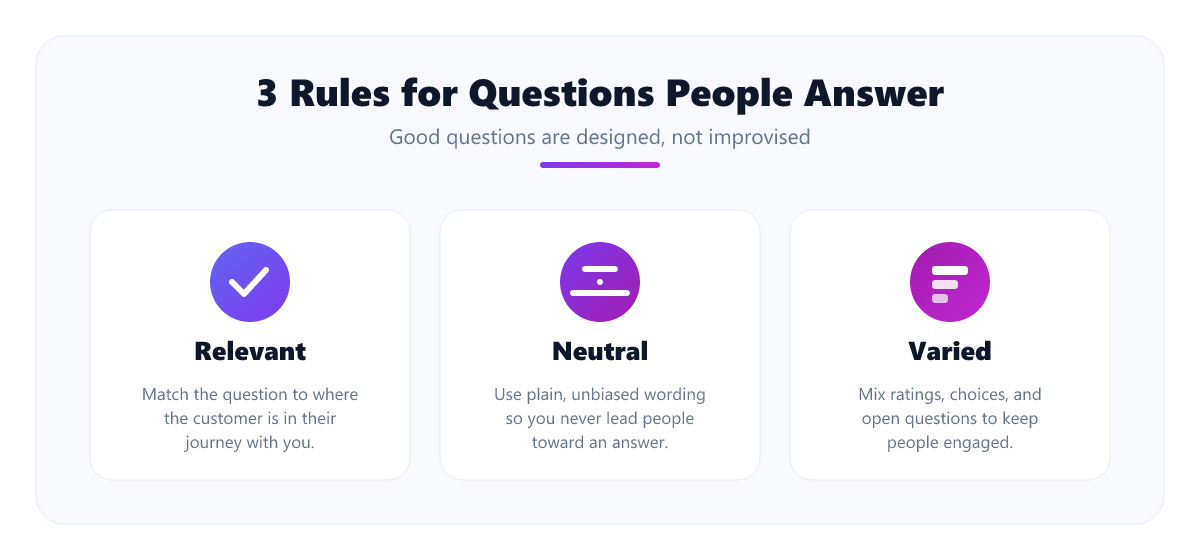
Prooflet is built around the same habits. Customers submit video, audio, or text testimonials themselves through your form, and each one is saved with its date and source. Forms can include a marketing consent statement, and every testimonial starts unapproved, so nothing appears on your site until you approve it. See the 3 rules of a good testimonial and how to ask for testimonials.
Frequently Asked Questions
1. Is it illegal to write fake testimonials?
Yes. In the US, the FTC's Consumer Reviews and Testimonials Rule (16 CFR Part 465), in effect since 21 October 2024, prohibits writing, buying, selling, or publishing fake consumer testimonials, including AI-generated ones. The FTC can seek civil penalties against knowing violators. Fake testimonials can also violate state consumer protection laws.
2. Does the FTC rule apply to testimonials on my own website?
Yes. The FTC says a business that puts testimonials on its own website is disseminating them, not merely hosting them, so it can be liable if they are fake or false.
3. Can I use AI to write testimonials?
Not as if a real customer wrote them. A testimonial that misrepresents that it came from someone who does not exist, including AI-generated ones, is banned by the rule. Using AI to fix typos in a real customer's testimonial, without changing its meaning and with their approval, is different.
4. Can I offer an incentive for a testimonial?
Yes, as long as the incentive is not conditioned, expressly or implicitly, on the testimonial being positive. The FTC also says failing to disclose an incentive can violate the FTC Act, so disclose it.
5. What is the penalty for fake testimonials?
The FTC can seek civil penalties against knowing violators of the rule: up to $51,744 per violation when the rule took effect in 2024, adjusted each year for inflation. Each fake testimonial can count as a separate violation.