14 Testimonial Ad Examples That Actually Convert
Updated
On this page
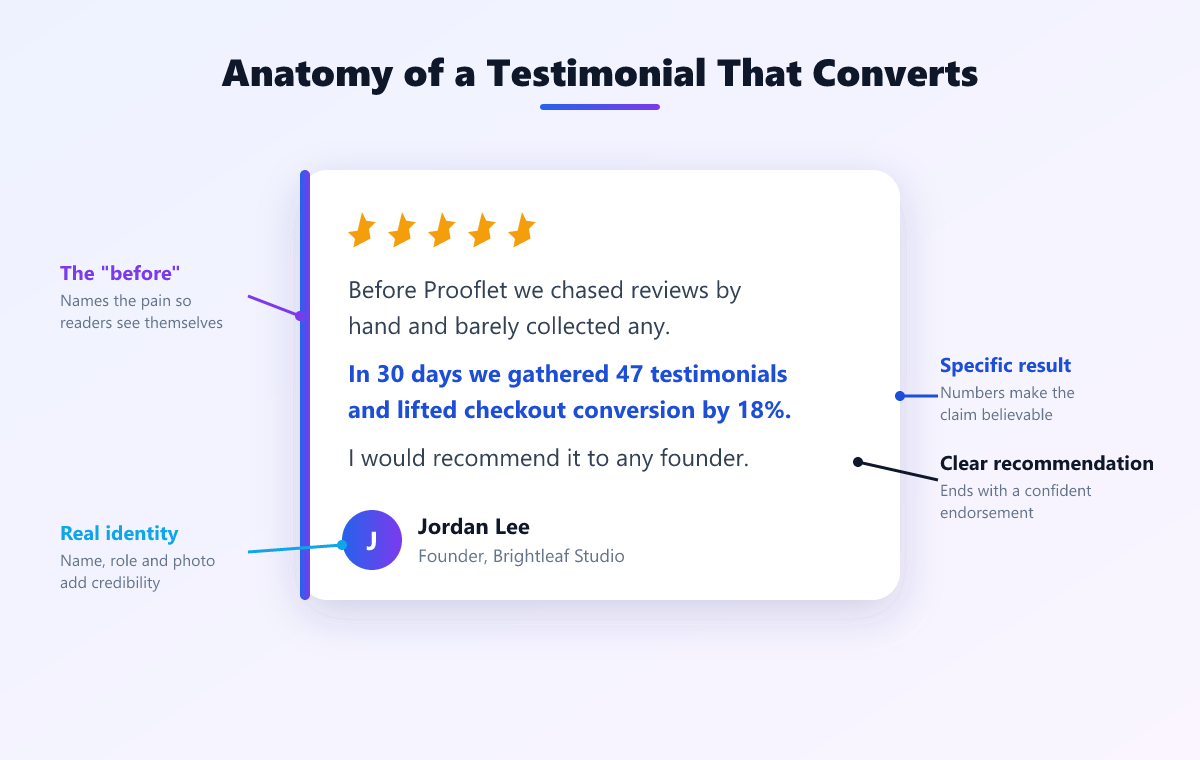
A testimonial ad puts the customer's words at the centre instead of the brand's. The ones that convert share four elements: a named person, a specific result, a visible face, and one clear call to action. Here are 14 examples across paid social, display and video.
The 4 elements of a testimonial ad that converts
- A named person. Full name, or first name with a role and company. “A happy customer” reads as invented.
- A specific result. A number or a before and after, stated in the first line or the first two seconds.
- A visible face. A real photo or real footage of the customer. Stock photos undo the whole ad.
- One clear call to action. One button, one next step. A testimonial earns attention; the call to action spends it.
14 testimonial ad examples
Each example is an illustrative ad concept showing the format, the copy, and why it works. Names are placeholders for your own customers, who must agree to appear.
Paid social testimonial ads (6)
1. Quote card in the feed (Facebook and Instagram, 1:1 static image)
“We went from one testimonial a quarter to 34 in six weeks.”
Dana Whitfield, Head of Growth, Lumen Labs
- Visual: Her photo on the left, the quote set large on the right
- Call to action: Start free
- Why it works: A face and a number stop the scroll. Keep the quote under 15 words so it reads at thumb speed.
2. Customer story in Stories (Instagram and Facebook Stories, 9:16 video, 15 seconds)
“I put off the course for a year. Twelve weeks later I had my first developer job.”
Priya N., course graduate
- Visual: Selfie-style video, captions burned in
- Call to action: Swipe up: see the syllabus
- Why it works: Vertical, phone-shot video looks native to Stories, so it reads as a person, not an ad.
3. B2B proof on LinkedIn (LinkedIn single image ad)
“Our cost per lead fell from $95 to $41 in six weeks.”
Marketing Manager, franchise brand (named in the ad)
- Visual: Headshot plus the company logo
- Call to action: Book a demo
- Why it works: LinkedIn buyers check the job title first. A peer with a respected title does the persuading.
4. UGC-style video (TikTok and Reels, 9:16 video, 20 seconds)
“Okay, I did not expect this to keep my coffee hot all day. Six hours later and it is still too hot to drink.”
Jess, verified customer
- Visual: Unpolished, talking to camera, product in hand
- Call to action: Shop now
- Why it works: Real customers filming themselves outperform polished spots on short-form platforms. Keep their words and their pauses.
5. Three-customer carousel (Facebook and Instagram carousel, 3 cards)
Card 1: “Set up in ten minutes.” Card 2: “22% more demos.” Card 3: “Replaced three tools.”
One named customer per card
- Visual: A different face on each card
- Call to action: Try it free
- Why it works: Three people with three results answer “is this just one happy customer?” before the viewer asks.
6. Screenshot of a real post (X or Facebook, image of a customer's post)
“ok the new booking page is live and we got 9 bookings overnight. wild.”
The customer's handle and date, with permission
- Visual: The original post, unedited
- Call to action: See how it works
- Why it works: An unprompted post carries its own proof. Get written permission and keep the handle visible.
Display testimonial ads (4)
7. Banner with one quote (Google Display, 300x250)
“Paid for itself in the first month.”
Sara Okafor, Finance Manager
- Visual: Small headshot, the quote, the logo
- Call to action: See pricing
- Why it works: Display banners get a glance, not a read. One six-word result is all the space allows.
8. Rating plus quote retargeting (Retargeting banner, 728x90)
4.9 from 1,200+ teams: “Best purchase we made this year.”
Dana Whitfield, Lumen Labs
- Visual: Star rating first, then the face
- Call to action: Finish signing up
- Why it works: Retargeted visitors already know you. The rating removes the doubt that made them leave.
9. Native article ad (Native placement, image and headline)
“We started opening proposals with 40-second client videos and won three bigger clients in one quarter.”
Tom Baker, Founder, Northgate Studio
- Visual: Photo of the founder at work
- Call to action: Read the story
- Why it works: Framed as a story, not an ad, so readers click to learn rather than to buy. The case study page does the selling.
10. Objection-answering banner (Retargeting banner for pricing page visitors)
“I hesitated at the price for a month. It paid for itself in six weeks.”
Operations Manager, 25-person agency (named in the ad)
- Visual: Headshot and the price
- Call to action: Compare plans
- Why it works: Shown only to people who viewed pricing, it answers the exact objection they left with.
Video testimonial ads (4)
11. 15-second pre-roll (YouTube in-stream, 15 seconds)
“We cut onboarding from three weeks to four days.”
Jon Park, COO, Relay Freight
- Visual: The customer on camera in the first two seconds
- Call to action: Watch the full story
- Why it works: The result lands before the skip button appears at five seconds. Put the number first.
12. 60-second customer story (YouTube and landing pages, 60 seconds)
“Before: 10 days to close the books. After: 3.”
CFO, 45-person manufacturer (named in the video)
- Visual: Interview shot, captions, one on-screen stat
- Call to action: Book a demo
- Why it works: Problem, change, result, in one minute. Long enough for the story, short enough to finish.
13. Before and after split screen (Vertical video, 10 to 20 seconds)
Left: the old spreadsheet. Right: the dashboard. “Four hours a week, gone.”
Named customer voiceover
- Visual: Split screen with the customer's face in a corner
- Call to action: Try it free
- Why it works: Showing the change is more convincing than describing it. Keep the customer visible so it stays a testimonial.
14. Connected TV spot (Streaming TV, 30 seconds)
“Our house sold in eleven days, over the asking price.”
Named homeowners, filmed at the home
- Visual: The couple on their doorstep
- Call to action: Get a free valuation
- Why it works: On a TV screen, a real family and a specific result feel like a neighbour's recommendation.
Testimonial ad mistakes that kill conversion
- Burying the result. If the number is in the last line of the ad or the last ten seconds of the video, most people never see it.
- Stock photos. Viewers recognise them, and the testimonial reads as fake.
- Over-scripting. A customer reading lines sounds like an actor. Interview them and cut the best answer instead.
- Two calls to action. “Book a demo or start a trial” splits the click. Pick one.
- An untypical result with no disclosure. See the rules below.
The rules for testimonial ads
In the US, testimonial ads fall under the FTC's Endorsement Guides, and fake testimonials are banned outright by the FTC's rule on consumer reviews and testimonials. Three rules matter most for ads:
- The testimonial must be real. A real customer, a real experience, and their honest opinion.
- Disclose any payment or free product. If the customer was compensated, the ad must say so clearly.
- Show typical results, or state them. If the result in the ad is better than what most customers get, the ad must clearly disclose what is typical.
Other countries have their own rules, such as the CAP Code in the UK. Check the rules where your ads run.
Where to get testimonials for ads
The best ad testimonials come from customers who already got a measurable result. Ask them a question with a number in the answer, offer video so you get footage, and record their consent to use it in advertising. Prooflet collects video, text, and audio testimonials through forms that can include a marketing consent statement, and the video is ready to cut into ads. See the video testimonials guide for filming tips and 20 testimonial examples for copy to adapt.
Frequently Asked Questions
1. What is an example of a testimonial ad?
A Facebook image ad showing a customer's photo beside the quote “We went from one testimonial a quarter to 34 in six weeks”, with her name, role, and company, and a “Start free” button. It contains all four elements that make testimonial ads convert: a named person, a specific result, a visible face, and one call to action.
2. What is an example of a testimonial advertisement?
A 15-second YouTube pre-roll in which a named customer says “We cut onboarding from three weeks to four days” in the first two seconds, before the skip button appears, and ends on a single call to action. Testimonial advertisements use a customer's words as the main message instead of the brand's.
3. Are testimonial ads effective?
Testimonial ads work when they include a named person, a specific result, a visible face, and one call to action. They persuade because the claim comes from a customer rather than the brand. Vague praise from an anonymous customer performs no better than brand copy.
4. Do testimonial ads need a disclaimer?
In the US, yes in two cases. If the customer was paid or given something for the testimonial, the ad must disclose it. If the result shown is not what most customers get, the ad must clearly state the typical result. The FTC's Endorsement Guides cover both.