Thank You for Your Feedback: 15 Response Templates That Work (2026)
Updated
On this page
- Responding to positive feedback
- 1. The short public reply
- 2. The detailed thank you
- 3. Thank you plus testimonial request
- 4. Thank you for a feature suggestion
- 5. Thank you to a long-term customer
- Responding to negative feedback
- 6. The public negative review reply
- 7. The service failure apology
- 8. When the customer is mistaken
- 9. The angry customer
- 10. The churn exit reply
- Responding to neutral or mixed feedback
- 11. The three-star review
- 12. The vague survey response
- 13. The feature request you are building
- Follow-up templates
- 14. The closed-loop follow-up
- 15. The no-response nudge
- The rules underneath the templates
- Turn positive feedback into published proof
- Frequently Asked Questions
A good reply to feedback does three things: it names the specific point the customer raised, says what you took from it, and states what happens next. Here are 15 templates for positive, negative, and mixed feedback, plus follow-ups.
Reply within 24 hours to negative feedback and within a few days to positive. Never use "we're sorry you feel that way", never paste the same reply twice on a public review page, and always follow a positive response with a request to share it as a testimonial.
Below are 15 templates covering positive feedback, negative feedback, neutral or mixed feedback, and follow-ups. Replace anything in [brackets]. The bracketed details are the whole point: a template with the brackets left generic is the auto-reply you were trying to avoid.
Responding to positive feedback
1. The short public reply
Use when: A positive public review on Google, G2, or Trustpilot.
Thanks so much, [name]. Really glad [specific thing they praised] worked well for you. [Team member they mentioned] will be happy to hear this. Shout if you need anything.
Why it works: Naming the specific thing and the team member proves a person read it. Keep public replies short; they are read by prospects, not just the reviewer.
2. The detailed thank you
Use when: A thoughtful positive email or survey response.
Subject: Thank you, this made our week
Hi [name],
Thank you for taking the time to write this. The part about [specific detail] stood out, because [why it matters to your team].
[Relevant next step or offer of help].
Thanks again,
[Your name]
Why it works: Reflecting back one specific detail shows you read it properly and invites more feedback later.
3. Thank you plus testimonial request
Use when: Positive feedback from a customer you would like to quote.
Subject: Thank you, and one small favour
Hi [name],
Thank you, that is genuinely good to hear. Especially [specific point], since [context].
Would you be open to us sharing what you said on our site? You can either reply "yes" and I will use your words as they are, or take 60 seconds here to record it yourself: [collection link].
Either way, no pressure at all.
[Your name]
Why it works: This is the highest-yield moment you will get. Offering both options, reuse or record, roughly doubles the response rate versus asking only for video.
4. Thank you for a feature suggestion
Use when: A customer suggests something you are not going to build soon.
Subject: Thanks for the [feature] suggestion
Hi [name],
Thank you for this. [Restate the suggestion in your own words] is a real gap, and you are not the first person to raise it.
Being straight with you: it is not in the next quarter's work. I have added it to the list with your note attached, and I will come back to you if that changes.
In the meantime, [workaround if one exists].
[Your name]
Why it works: Honesty about the timeline preserves trust. A vague "we'll look into it" is remembered as a promise.
5. Thank you to a long-term customer
Use when: A renewal, milestone, or anniversary.
Subject: Three years, thank you
Hi [name],
[Time period] with us this month. Thank you.
You were one of the people who told us [specific early feedback], and that changed [what it changed]. That is not a small thing.
[Any relevant offer or next step].
[Your name]
Why it works: Showing that their past feedback changed something is the strongest loyalty signal you can send.
Responding to negative feedback
6. The public negative review reply
Use when: A critical public review.
Hi [name], thank you for being direct about this. You are right that [acknowledge the specific failure], and that is on us. [What you have changed or are changing]. I would like to sort out your situation properly, so I have emailed you at the address on the account, or you can reach me at [contact].
Why it works: Written for the prospect reading it, not only the reviewer. Acknowledging the failure plainly and moving the detail off-platform is the standard that works.
7. The service failure apology
Use when: You clearly got something wrong.
Subject: About [specific issue]
Hi [name],
We got this wrong. [Plain description of what happened, no jargon].
What we have done: [immediate fix]. What we are changing so it does not recur: [process change].
[Concrete remedy: refund, credit, replacement].
Sorry for the trouble this caused.
[Your name]
Why it works: No hedging, no passive voice, no "we apologise for any inconvenience." Say what broke, what you did, what changes.
8. When the customer is mistaken
Use when: The complaint rests on a misunderstanding.
Subject: Let me clear this up
Hi [name],
Thank you for raising this, and sorry it has been confusing.
[Explain what actually happens, neutrally]. I can see why it read the other way: [acknowledge the genuine ambiguity].
We are [improving the wording or the flow] so the next person does not hit the same thing.
Anything else I can clear up?
[Your name]
Why it works: Correct the facts while conceding the ambiguity. Never make a customer feel stupid, especially in public.
9. The angry customer
Use when: Feedback written in obvious frustration.
Subject: I hear you, let me fix it
Hi [name],
You have every right to be frustrated. [Restate the problem in one sentence so they know you understood it].
Here is what I am doing right now: [immediate action, with a time].
I will come back to you by [specific time] either way.
[Your name and direct contact]
Why it works: Match the tone down, not up. A specific commitment with a time does more to defuse anger than any amount of apology.
10. The churn exit reply
Use when: A customer cancels and explains why.
Subject: Thank you for telling us why
Hi [name],
Sorry to see you go, and thank you for telling us why. [Specific reason] is fair.
[If fixable: what you are doing and when. If not: acknowledge it honestly.]
Your data will be available to export until [date]. If you ever want to come back, [what that looks like].
All the best,
[Your name]
Why it works: Graceful exits produce returning customers and honest referrals. Trying to save the account here usually backfires.
Responding to neutral or mixed feedback
11. The three-star review
Use when: Balanced feedback, some good and some bad.
Thanks [name], this is useful precisely because it is balanced. Glad [the positive] landed. On [the negative], you are right, and [what you are doing about it]. If you would tell me more about [specific point], I would like to hear it: [contact].
Why it works: Mixed reviews are the most credible ones on a page. Engaging seriously invites the reviewer to update it later.
12. The vague survey response
Use when: Feedback too general to act on.
Subject: Can I ask what you meant by [X]?
Hi [name],
Thank you for the response to [survey]. You mentioned [their vague phrase] and I would like to make sure I understand it properly.
Could you tell me about a specific moment where that came up? Even one example helps more than you would think.
[Your name]
Why it works: Asking for one concrete moment turns unusable feedback into something you can act on.
13. The feature request you are building
Use when: They asked for something already on the roadmap.
Subject: You are going to like this
Hi [name],
Good timing. [Feature] is in progress and should land around [rough timeframe].
Since you raised it, would you want early access to try it before it ships? Your feedback at that point would be genuinely valuable.
[Your name]
Why it works: Converts a request into a beta tester and, usually, into a testimonial once it ships.
Follow-up templates
14. The closed-loop follow-up
Use when: You have shipped the fix they asked for.
Subject: You asked for this, it is live
Hi [name],
Back in [month] you told us [their feedback]. That is live as of today: [what changed and where to find it].
Thank you for pushing on it. If it is not quite what you needed, tell me and we will keep going.
[Your name]
Why it works: The highest-value message in this list. Closing the loop months later creates advocates, and it is the natural moment to ask for a testimonial.
15. The no-response nudge
Use when: You replied to feedback and heard nothing back.
Subject: Still happy to help with [issue]
Hi [name],
Following up on [issue] from [date]. I have not heard back, which might mean it is sorted, or might mean it is not.
If it is still open, reply here and I will pick it straight up. If it is resolved, no need to do anything.
[Your name]
Why it works: Gives an explicit way to not reply, which paradoxically increases replies.
The rules underneath the templates
- Be specific or do not bother. If your reply would work under any other comment, it is noise.
- Speed beats polish. A plain reply in two hours outperforms a considered one in two weeks.
- Never say "we're sorry you feel that way." It relocates the problem into the customer's head.
- Vary public replies. Five identical thank-yous in a row on a review page are visibly automated.
- Close the loop. Telling someone their feedback changed something is what turns a customer into an advocate.
Turn positive feedback into published proof
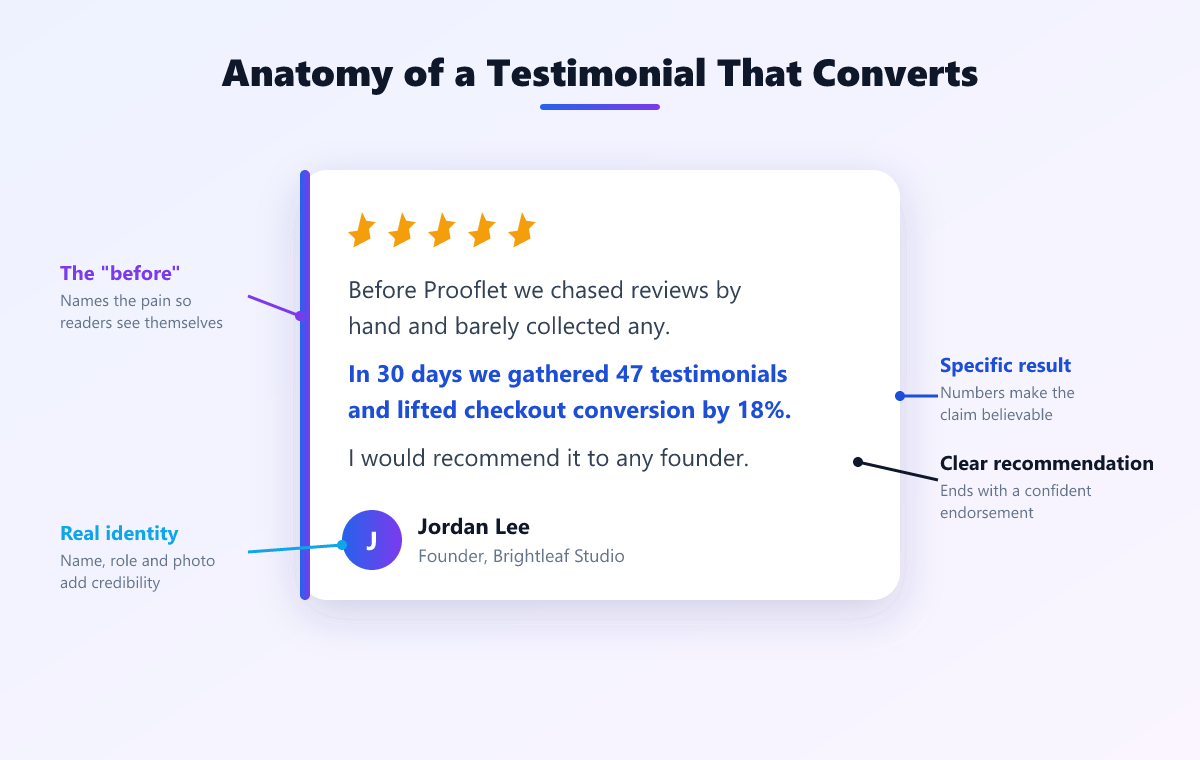
Most positive feedback is read once and forgotten. Someone emails to say your team was great, you thank them, and that is the end of it, even though it was a testimonial that just needed permission.
Build one habit: every time you send a template from the positive section above, ask whether you can publish it. Template 3 exists for exactly that. Our testimonial request email templates cover the follow-up, and how to respond to negative reviews goes deeper on the public side.
Prooflet keeps the proof in one place: collect video, text, and audio through a branded form, import reviews you already have from Google, LinkedIn, G2, and 30 or so other platforms, and publish it with one line of code. See the plans.
Frequently Asked Questions
1. How do you say thank you for feedback professionally?
Name the specific thing they raised, say what you took from it, and state what happens next. "Thank you for your feedback" on its own reads as an auto-reply. "Thank you for flagging the delay on the export step, we have moved it to this sprint" reads as a person who listened.
2. Should you respond to every piece of feedback?
Respond to every piece of feedback that names something specific, and to every negative review in public. You can skip a purely generic positive rating with no comment, though a short thank you still helps. Public reviews matter most, because your reply is read by future customers rather than only the reviewer.
3. How quickly should you respond to feedback?
Within 24 hours for negative feedback and within a few days for positive. Speed does most of the work on a complaint: a fast, plain reply defuses far more than a perfect one written a week later.
4. What should you not say when responding to feedback?
Avoid "we're sorry you feel that way", which blames the customer for their reaction rather than addressing the problem. Avoid copy-pasted replies, which are obvious when several appear in a row on a review page. Avoid arguing the facts in public, and avoid promising a fix you cannot deliver.
5. Can I ask for a testimonial after someone gives positive feedback?
Yes, and it is the single best moment to ask. Someone who just told you they are happy has already written most of a testimonial. Thank them first, then ask in the same message whether you can share what they said, or send a link so they can record it properly.